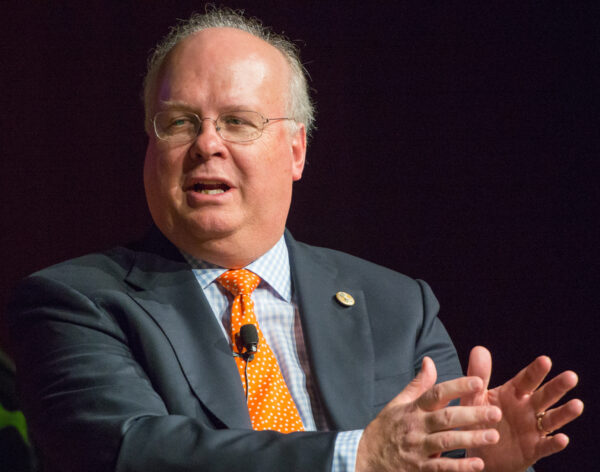
Fox News contributor Karl Rove cautioned that a mix of political maneuvering and broader national dissatisfaction could put the Republican Party’s House majority at risk, even as both parties scramble to gain an edge ahead of the midterm elections.
Speaking with Trey Gowdy on Sunday evening, Rove took aim at what he described as a familiar but troubling trend: both Republicans and Democrats focusing heavily on redistricting battles instead of addressing what he called “the business of the people.” While acknowledging that such tactics are nothing new, Rove suggested they offer little real benefit to voters and may ultimately carry unintended consequences.
Gowdy raised the question of whether aggressive redistricting efforts could backfire, asking if attempts to maximize partisan advantage might win short-term gains while undermining long-term stability. Rove agreed, outlining how both parties could inadvertently create more competitive districts by overreaching.
He pointed to examples in states like Texas, where heavily Democratic urban areas could be divided and distributed across suburban and rural districts. While such moves might dilute Democratic strongholds on paper, they could also leave Republican-held districts more vulnerable in a volatile election cycle. Similar dynamics, he noted, could play out across the South, where traditionally Democratic-leaning Black communities might be split across multiple districts, potentially reshaping electoral outcomes in unpredictable ways.
“Nothing ever plays out exactly in politics as we think it does,” Rove observed, underscoring the uncertainty that often accompanies even the most carefully drawn political maps.
Rove then laid out the competing expectations from both parties. Democrats, he said, believe they could gain between four and five seats in California and one in Utah, for a potential pickup of five to six seats through redistricting alone. Republicans, meanwhile, are eyeing gains in several states, including three to five seats in Texas, along with possible pickups in Missouri, Ohio, Louisiana, Alabama, Tennessee, and South Carolina.
Even under optimistic projections for Republicans, Rove suggested the net gain might be modest—perhaps three to six seats after accounting for Democratic advances. While that could be enough to maintain control of the House, he warned that such a narrow margin leaves little room for error, particularly in a political environment shaped by broader public dissatisfaction.
That “malaise,” as Rove described it, could prove decisive. With the president’s approval rating where it stands and a general sense of unease among voters, he expressed skepticism that Republican losses would remain minimal. History has often shown that the party in power faces headwinds during midterm elections, and Rove indicated there is little reason to believe this cycle will be any different.
Underlying his comments is a larger concern about the direction of national politics. As both parties focus on tactical advantages like redistricting, issues weighing on everyday Americans—rising costs, economic uncertainty, and the consequences of decisions made in Washington—continue to shape voter sentiment. Those pressures, rather than carefully drawn district lines, may ultimately determine control of Congress.
In the end, Rove’s warning reflects a broader reality: political strategy can only go so far in the face of a restless electorate. When public confidence wanes, even the most meticulously planned electoral maps may struggle to hold back a shifting political tide.
[READ MORE: Trump Enlists Postal Service in Push to Tighten Mail-In Voting Rules]