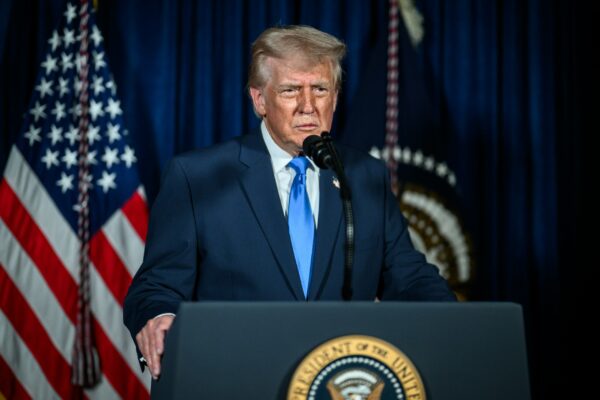
President Donald Trump unleashed sharp criticism Wednesday following the outcome of a Virginia ballot referendum that clears the way for a Democratic-backed redistricting plan, calling the result a “rigged election” in a fiery post on Truth Social.
The president pointed to what he described as a late surge in mail-in ballots, arguing that Republicans had been leading throughout the day before the final tally shifted. Referencing familiar grievances, Trump likened the outcome to his long-standing claims about the 2020 election, asserting that Democrats secured what he called a “crooked victory” after a last-minute ballot influx.
Trump also took aim at the structure of the referendum itself, arguing that the language presented to voters was confusing and difficult to understand. He claimed that even he struggled to make sense of the wording, suggesting that the measure was intentionally designed in a way that obscured its true impact. The president expressed hope that the courts might ultimately intervene, framing the situation as a broader issue of fairness and transparency.
At the center of the controversy is a redistricting effort that could significantly reshape Virginia’s congressional map. Trump argued that the proposed changes would tilt the balance heavily in favor of Democrats, contrasting it with what he described as a closely divided electorate in recent presidential voting. The outcome, he suggested, does not reflect the political reality on the ground.
Despite his criticism, Trump’s stance highlights a broader tension within American politics, where both parties have at times pursued aggressive redistricting strategies when given the opportunity. The debate over where to draw the line between political advantage and electoral fairness remains unresolved, and increasingly contentious.
Earlier in the day, James Blair, who is currently on leave to lead Trump’s midterm political operation, offered a more measured take during an appearance on CNN. Speaking with anchor Dana Bash, Blair argued that the results, while not a victory for Republicans, may signal underlying momentum for the party.
Blair pointed to Virginia’s recent election history, noting that Democrats had won statewide races in 2025 by wide margins. Against that backdrop, he emphasized that the referendum result was decided by just three points, which he characterized as an overperformance relative to previous Republican showings tied to Trump’s 2024 results in the state.
From Blair’s perspective, the narrower margin suggests that Republicans could be better positioned heading into the midterms than critics assume. He argued that if similar patterns hold nationwide, the GOP could make gains in both the House and Senate, potentially reshaping the balance of power in Washington.
The contrast between Trump’s forceful rhetoric and Blair’s strategic optimism reflects the dual tracks often seen in modern political messaging—one focused on energizing the base, the other on reading electoral tea leaves for future contests.
Still, the broader issue of redistricting continues to raise concerns about the health of the political system. As both parties engage in increasingly aggressive efforts to redraw maps in their favor, questions linger about whether voters are choosing their representatives—or whether representatives are choosing their voters.
With legal challenges potentially looming and the midterm elections approaching, the fallout from Virginia’s referendum is likely to extend well beyond state lines, serving as another flashpoint in an already heated national debate over election integrity and political power.
[READ MORE: Appeals Court Backs Texas Ten Commandments Law, Setting Stage for Supreme Court Clash]