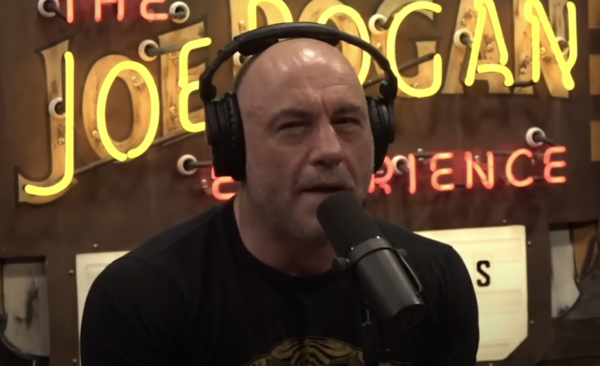
Podcast host Joe Rogan is once again voicing frustration with America’s political landscape, saying he feels increasingly disconnected from both major parties — even as he has grown more critical of President Donald Trump, whom he backed late in the 2024 election.
During a recent episode of “The Joe Rogan Experience,” Rogan sat down with comedian Arsenio Hall and discussed what he described as a deeply flawed two-party system. According to Rogan, Americans are often pushed into choosing sides rather than evaluating issues on their merits.
“You’re just being manipulated, and you’ve been manipulated by these two teams, and you have to pick a team,” Rogan said, likening modern politics to a forced allegiance rather than a thoughtful process. Hall echoed the sentiment, calling the dynamic frustrating, while Rogan dismissed it outright as “so stupid.”
Rogan went further, describing himself as “politically homeless,” a label he said reflects years of dissatisfaction with both Democrats and Republicans. He argued that rigid ideological divisions prevent meaningful progress, as each side reflexively rejects ideas simply because they originate from the opposing camp.
“We need like a logical centrist government,” Rogan said, suggesting that practical solutions often get lost in partisan conflict. He criticized what he sees as a culture where political identity overrides independent thinking, comparing it to sports rivalries where loyalty matters more than reason.
Rogan’s political positioning has long been difficult to categorize. While he has described himself as socially liberal and fiscally conservative, he has largely avoided aligning fully with either major party. In 2016, he endorsed Libertarian candidate Gary Johnson and has been a longtime supporter of former Congressman Ron Paul, known for his libertarian-leaning views.
His late endorsement of Donald Trump in the 2024 election marked a notable shift, but Rogan now appears more willing to openly criticize the president. During his conversation with Hall, he pointed to Trump’s mass deportation efforts as one area of concern.
Rogan also raised questions about the administration’s actions abroad, suggesting that the decision to launch the Iran war may have been influenced by domestic political pressures. Specifically, he claimed it could have served as a distraction from criticism surrounding the Department of Justice’s release of files tied to Jeffrey Epstein.
While Rogan did not offer detailed evidence for that claim, the comment reflects a broader skepticism he expressed about how political leaders operate, particularly in times of heightened controversy. His remarks also underscore a growing unease among some commentators about the intersection of foreign policy decisions and domestic political narratives.
More broadly, Rogan argued that many Americans gravitate toward rigid ideologies because they provide a sense of certainty. He suggested that adopting a fixed set of beliefs can make it easier for individuals to navigate complex issues without engaging in deeper analysis.
“There’s a lot of people out there that are not that — they’re not open-minded,” Rogan said, describing what he sees as a tendency to embrace predetermined viewpoints rather than think independently.
His comments reflect a wider debate about the state of political discourse in the United States, where polarization has intensified in recent years. At a time when both domestic divisions and international conflicts continue to dominate headlines, Rogan’s remarks highlight a frustration shared by some who feel caught between competing narratives.
Whether that sentiment translates into a broader shift away from traditional party loyalties remains to be seen. For now, Rogan’s self-described “political homelessness” speaks to a growing sense that, for some Americans, neither side fully represents their views in an increasingly divided landscape.
[READ MORE: Trump Threatens “Large-Scale Attacks” as Iran Dispute Tests Fragile Ceasefire]