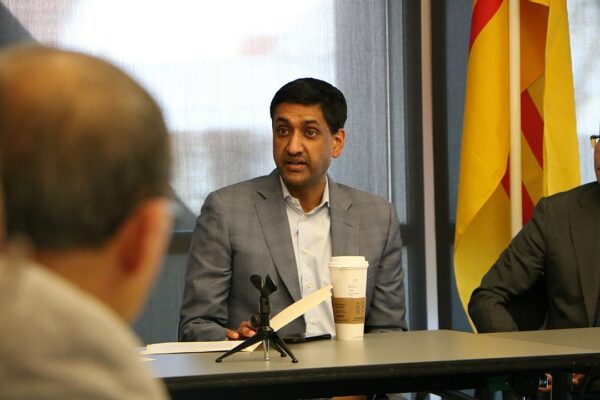
Rep. Ro Khanna (D-CA) is now reportedly pointing to an unlikely coalition of voices—including prominent conservatives—for helping push President Donald Trump toward his decision to agree to a two-week ceasefire with Iran.
Speaking in a video posted to social media, Khanna said the president’s Tuesday night announcement to pause military action came after mounting criticism not just from the political left, but from influential figures on the right. Among those he credited were Tucker Carlson, former Rep. Marjorie Taylor Greene, and conservative pundit Ann Coulter.
The ceasefire followed a tense buildup in which Trump had warned of severe consequences if Iran failed to meet his demands by a Tuesday evening deadline. The president had previously threatened to target civilian infrastructure if an agreement was not reached—rhetoric that drew sharp backlash across the political spectrum.
Khanna argued that this backlash played a decisive role in changing the course of events. According to the congressman, it was the collective pressure from the American public—spanning ideological divides—that helped steer the administration away from further escalation and toward diplomacy.
“As a human being and as an American citizen, I am relieved,” Khanna said, referring to Trump’s decision to halt strikes and accept the ceasefire proposal, which came after a request from Pakistan to extend the deadline by two weeks.
He contrasted that public pressure with what he described as a lack of action from Congress. In his remarks, Khanna criticized lawmakers for failing to assert themselves during a moment of high stakes, saying the institution “barely made a whimper” as tensions escalated.
At the center of Khanna’s argument is a broader point about political accountability. He emphasized that opposition to the threat of large-scale destruction in Iran was not limited to one party or ideology. Carlson had publicly criticized Trump’s rhetoric, particularly his use of profanity in a social media post demanding Iran reopen the Strait of Hormuz. Greene went even further, calling for the invocation of the 25th Amendment after Trump warned that “a whole civilization will die tonight” if his demands were not met.
Khanna framed these responses as part of a wider public reaction against the prospect of intensified conflict. He suggested that voices from across the political spectrum—combined with what he described as the will of the American people—helped create the conditions for a diplomatic pause.
The episode highlights a rare moment of alignment among figures who often disagree on nearly everything else. While the ceasefire itself is temporary, the circumstances surrounding it point to a broader unease about the consequences of escalating military action.
Khanna ultimately argued that this kind of cross-partisan pressure may be essential moving forward. He described the moment as evidence that a broad-based public movement—one that cuts across traditional political lines—can influence decisions at the highest levels.
For now, the two-week pause offers a window for negotiations and a break from immediate escalation. But as Khanna’s remarks make clear, the debate over how—and whether—to pursue further conflict is far from settled.
[READ MORE: Trump Says He Will Slap Tariffs On Anyone Supplying Iran With Weapons]