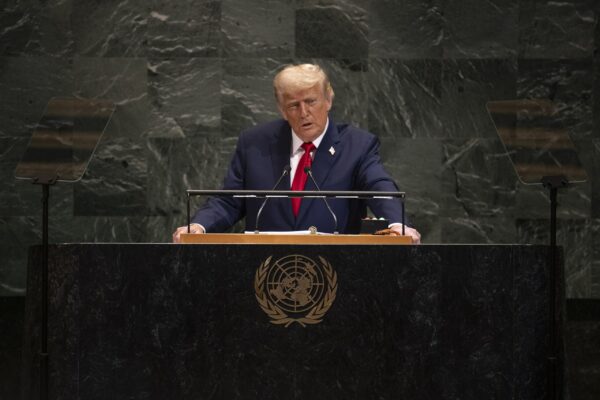
President Donald Trump on Monday blasted critics of the reported agreement his administration is now reportedly negotiating with Iran, arguing that opponents inside both parties are attacking details that have not even been finalized as efforts continue to end nearly three months of conflict in the Middle East.
The reported negotiations come amid ongoing attempts to reopen the Strait of Hormuz and establish a broader agreement between Washington and Tehran. While several reports suggest the two sides are nearing a deal, major elements reportedly remain under discussion.
Trump used his Truth Social platform to dismiss critics of the emerging framework, targeting Democrats as well as Republicans who have voiced skepticism about the negotiations.
“I laugh at all of the Dumocrats, RINOS, and Fools who know nothing about the potential deal I am making with Iran, things that haven’t even been negotiated yet,” Trump wrote.
The president specifically singled out Sens. Thom Tillis and Bill Cassidy, along with Rep. Thomas Massie, accusing them of joining Democrats in undermining his administration.
According to Trump, those lawmakers have spent their time “constantly supporting bad policy and even worse candidates” while criticizing “each and every fantastic win” achieved by his administration.
Reports from multiple outlets indicate that U.S. officials and Iranian negotiators are moving closer toward an agreement. CBS News reported that one proposed framework would involve the United States lifting its naval blockade of Iranian ports in exchange for Iran disposing of its highly enriched uranium stockpile. The report also stated that the administration could ease sanctions on Tehran as part of the arrangement.
The possibility of sanctions relief and reduced military pressure has already sparked concern among some Republicans who fear the agreement could mirror past diplomatic efforts with Iran.
Tillis criticized the reported terms during an appearance Sunday on CNN’s “State of the Union,” telling host Jake Tapper that the deal did not “make sense” to him.
Cassidy, who earlier this month lost his primary to Trump-backed Rep. Julia Letlow, recently voted in favor of a resolution requiring congressional authorization before the president could use military force against Iran.
That resolution passed the Senate earlier this week by a 50-47 vote, setting up a future procedural vote once lawmakers return from recess on June 1.
Massie, meanwhile, has consistently backed measures limiting presidential war powers regarding Iran. The Kentucky congressman also recently lost his primary race to a challenger endorsed by Trump.
Responding to the criticism Monday, Trump argued that his opponents were contributing only “division and loss.”
“These people should go home and rest, they do nothing but create division and loss,” Trump wrote. “In other words, they are losers!”
The president insisted any final agreement would differ sharply from the Obama-era nuclear deal known as the JCPOA, which Trump has repeatedly condemned.
“It will be the exact opposite of the JCPOA disaster negotiated by the failed Obama Administration,” Trump wrote, calling the 2015 agreement “a direct and open path to a Nuclear Weapon for Iran.”
“No, I don’t do deals like that!” he added.
Shortly afterward, Trump posted a Memorial Day message praising the military while again criticizing Democrats.
“Happy Memorial Day to all, including the Dumocrats, who disrespect our Military and all of the tremendous success that it has had over the last year,” Trump wrote. “God Bless those that have made the ultimate sacrifice. I love you all!”
Secretary of State Marco Rubio also defended the administration’s negotiations during remarks from India, dismissing claims that the reported deal would strengthen Iran’s nuclear ambitions.
“The idea that somehow this president — given everything he’s already proven he’s willing to do — is going to somehow agree to a deal that ultimately winds up putting Iran in a stronger position when it comes to nuclear ambitions is absurd,” Rubio said.
As debate intensifies inside the Republican Party, the negotiations highlight the difficult balancing act facing the administration: avoiding a wider regional war while convincing critics that diplomacy will not come at the expense of American leverage or long-term security.
[READ MORE: Trump Says He’s In No Rush For Iran Settlement]