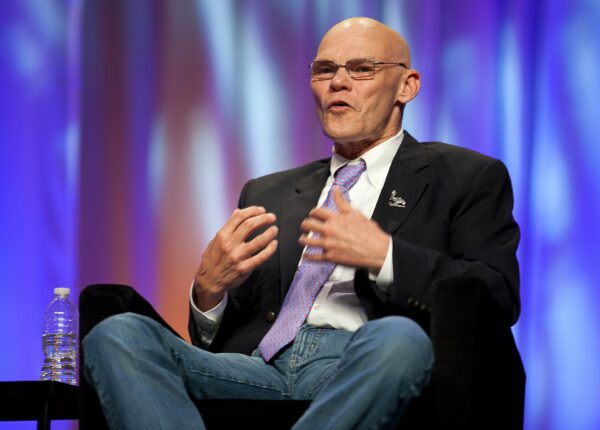
Veteran Democratic strategist James Carville is reportedly once again making headlines, this time with a sweeping and highly contentious prediction about the political future of President Donald Trump.
In a video released Wednesday by Politicon, Carville argued that Trump will be out of office within the next year, suggesting the president could ultimately resign following the midterm elections. The longtime political operative paired that prediction with a barrage of personal insults, continuing a pattern of fiery rhetoric that has come to define much of today’s political discourse.
Carville claimed he is confident Democrats will perform strongly in the midterms, going so far as to compare the anticipated political impact on Trump to being hit by heavyweight boxing legend Mike Tyson. According to Carville, such an outcome would leave the president politically isolated and facing mounting pressure from multiple directions.
Looking ahead to what he described as Trump’s “post-November future,” Carville painted a bleak picture. He suggested that political allies and contacts would distance themselves, arguing that many would see Trump as a liability rather than an asset. He further predicted that Democrats would launch extensive investigations into the president and his administration, including scrutiny over alleged financial misconduct involving Trump and members of his family.
Carville also raised the possibility of international scrutiny tied to Trump’s handling of military strikes against Iran, signaling that political battles over foreign policy decisions could extend beyond U.S. borders. While such claims remain speculative, they reflect the broader political tensions surrounding the conflict and its potential legal and political consequences.
In addition to pressure from Democrats, Carville asserted that Republicans themselves could begin to turn on Trump if political winds shift. He suggested that GOP senators, while currently aligned with the president for political reasons, could ultimately view him as a “losing bet” if electoral outcomes weaken the party’s standing.
Carville went even further, predicting that the House of Representatives would move to impeach Trump in 2027 and that Senate Republicans could eventually abandon their support. The remarks highlight not only his confidence in Democratic electoral prospects but also the degree to which partisan divisions continue to shape expectations about the future.
Perhaps most notably, Carville speculated that Trump might seek an exit strategy by negotiating a deal that would involve his resignation. In that scenario, Carville suggested, Vice President J.D. Vance could issue a pardon, allowing Trump to leave office while avoiding certain legal consequences. At the same time, Carville noted that such a pardon would not apply to potential state-level cases or actions by international bodies.
While Carville’s remarks were laced with sarcasm and sharp language, they underscore a broader reality in American politics: a climate increasingly defined by high-stakes predictions, personal attacks, and deep partisan divides particularly by far-left personalities like Carville. His comments also reflect the extent to which debates over leadership, accountability, and foreign policy — particularly regarding conflicts like Iran — are likely to remain central in the months ahead.