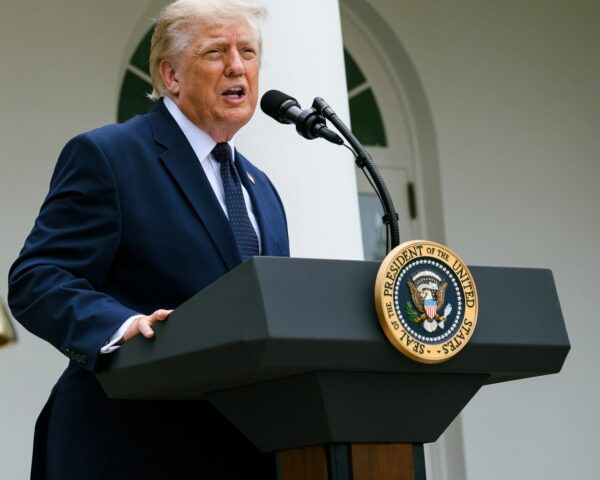
President Donald Trump sharply criticized The Wall Street Journal during a Cabinet meeting Thursday, rejecting a report that suggested he is eager to bring the U.S. operation in Iran to a quick end.
The president’s remarks came during an exchange with Fox News correspondent Jacqui Heinrich, who raised concerns circulating among Gulf States that the United States might withdraw from the conflict prematurely. Trump brushed aside those concerns, instead emphasizing what he described as the strength and effectiveness of American military capabilities, particularly missile defense systems.
When pressed further about whether Iran may still possess enriched uranium, Trump responded with confidence in the current trajectory of the operation, while also pivoting to a broader critique of media coverage surrounding the conflict.
“Well, you’re going to have to see,” Trump said, before asserting that the United States is in “very good shape.” He described U.S. air activity in sweeping terms, saying American forces are “roaming free” over Iranian skies with “the most beautiful planes you’ve ever seen,” adding that there is little Iran can do in response.
From there, the president turned his attention to what he called “fake news,” singling out both The New York Times and The Wall Street Journal. Trump took particular issue with a Journal report claiming he was “desperate” to make a deal or exit the conflict.
“I read a story today that I’m desperate to make a deal. I’m not,” Trump said. “If I was desperate, he’d be the first to know,” he added, gesturing toward Defense Secretary Pete Hegseth.
In a moment that underscored his defiance, Trump insisted the opposite is true. “I’m the opposite of desperate. I don’t care,” he said, while also revealing that additional military targets remain under consideration. According to the president, U.S. forces are striking targets on a daily basis, though he declined to offer specific details.
That refusal, Trump suggested, is intentional. He argued that openly discussing military plans could compromise operations, even as he acknowledged that some critics believe such disclosures would make little difference. “Maybe it does matter. Who knows?” he said, before reiterating that he would not elaborate.
The exchange took a lighter turn when Trump briefly apologized to Heinrich for putting her on the spot, calling her a “friendly reporter,” though he quickly returned to emphasizing the limits of what he could publicly disclose. He joked that revealing too much could lead to consequences as severe as invoking the Twenty-fifth Amendment.
While the president projected confidence in the ongoing campaign, the moment highlighted a familiar tension: the push to demonstrate strength abroad while navigating skepticism at home over both strategy and messaging. Trump’s insistence that he is not rushing for the exit stands in contrast to reports suggesting otherwise, leaving a gap between official rhetoric and outside perceptions.
As the operation continues, the administration appears determined to maintain pressure while tightly controlling information. Yet even amid declarations of progress, the uncertainty surrounding the conflict—and the questions it raises about duration and cost—remains an undercurrent that cannot be easily dismissed.
[READ MORE: Iran Fortifies Kharg Island as U.S. Weighs Potential Military Move]