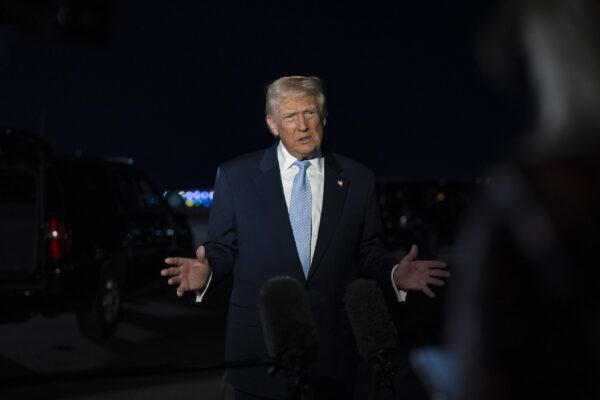
President Donald Trump is now reportedly raising fresh questions about the role of U.S. allies in securing one of the world’s most critical energy corridors, suggesting that responsibility for the Strait of Hormuz could ultimately shift away from the United States once its current military operation against Iran concludes.
In a series of posts on Truth Social Wednesday, Trump floated the idea that countries more dependent on the strategic waterway should take on a greater share of its defense—particularly after what he described as the U.S. effort to “finish off” Iran’s regime. His remarks come as the ongoing conflict has intensified pressure on global energy markets and exposed long-standing tensions between the United States and some of its international partners.
“I wonder what would happen if we ‘finished off’ what’s left of the Iranian Terror State, and let the Countries that use it, we don’t, be responsible for the so-called ‘Strait?’” Trump wrote. He added that such a move might push what he called America’s “non-responsive allies” to act more decisively.
The comments follow a wave of retaliatory drone and missile strikes launched by Iran targeting Gulf states and U.S. military assets in the region since the start of Operation Epic Fury on February 28. The attacks have effectively shut down the Strait of Hormuz, a narrow but vital passage that serves as a key artery for global oil shipments. The disruption has triggered calls from Washington for broader international involvement to restore access and stabilize the situation.
Trump’s frustration appears to be directed particularly at NATO members, who he has repeatedly urged to take a more active role in securing the strait. Many of these countries rely heavily on the route for energy imports, a point the president has emphasized in recent days as he presses for greater burden-sharing.
In another post, Trump doubled down on his stance toward Iran, calling it the “NUMBER ONE STATE SPONSOR OF TERROR” and asserting that U.S. actions are rapidly weakening its position. The administration’s approach reflects a belief that decisive measures can alter the balance of power in the region, though the unfolding situation also highlights the unpredictable consequences that can accompany escalating conflict.
The closure of the Strait of Hormuz has underscored how quickly regional tensions can ripple outward, affecting not just military dynamics but also global economic stability. With energy shipments disrupted and uncertainty rising, the question of who ultimately bears responsibility for safeguarding critical infrastructure has taken on renewed urgency.
Trump’s suggestion that the U.S. could step back from directly defending the strait after its current objectives are achieved points to a broader debate about America’s role on the world stage. For years, U.S. leaders have called on allies to contribute more to shared security challenges, particularly in regions where their own economic interests are at stake.
At the same time, the situation illustrates the high stakes involved when military operations intersect with global supply chains. While calls for allies to step up may resonate with those concerned about fairness and burden-sharing, the path forward remains uncertain as the conflict continues to unfold.
As Washington seeks international support to reopen the strait, Trump’s remarks serve as both a challenge and a warning—highlighting the growing impatience with allies, while also reflecting the broader costs and complexities tied to ongoing military engagements abroad.
[READ MORE: Trump Dismisses Vietnam Comparison as Iran Conflict Enters Third Week]