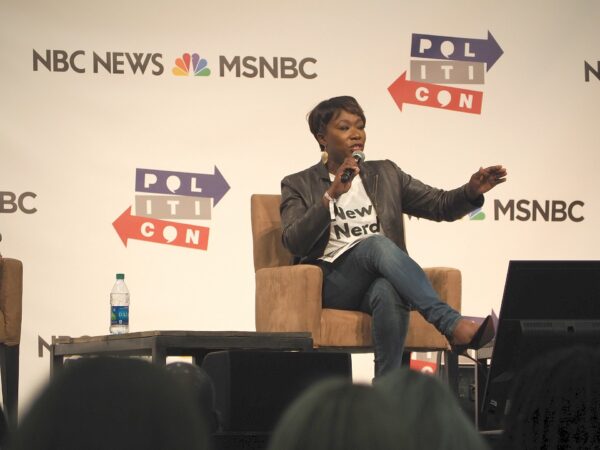
Former MSNBC host Joy Reid is drawing criticism after arguing that the United States is only “marginally” better than the Iranian regime, comments that came as American forces remain engaged in a war with Iran.
Reid made the remarks during an appearance on last Wednesday’s episode of the podcast One54, hosted by Akbar Gbajabiamila and comedian Godfrey. During the conversation, Reid suggested that the American public is often presented with a simplified narrative about global conflicts, particularly those involving countries in the Middle East, Africa, or South America.
According to Reid, context surrounding those conflicts is frequently left out of mainstream discussions.
“We get told, particularly when it comes to Arabs and Muslims and Africans, that people are just diabolically evil for no reason, right?” Reid said during the podcast.
She argued that Americans are often told foreign adversaries act out of pure hostility toward the United States, citing past narratives surrounding Iraq as an example.
“That they do things because they hate our freedoms,” Reid said. “We were told this about Iraq, that they just hated us for no damn reason at all.”
Reid then claimed that tensions between the United States and Iran have historical roots that are rarely explained to the public. She pointed to the 1953 coup in Iran that was backed by American and British forces as a major source of resentment.
“So there’s no reason why Iran would hate us,” Reid said sarcastically. “But it turns out there’s a lot of reason why Iran should hate us.”
She continued by arguing that Americans are frequently given what she described as a misleadingly “objective” narrative about conflicts involving what she called “global south countries,” including Muslim and African nations.
“We took their freedom and we don’t get told that,” Reid said. “And so Americans get fed this false, objective story — particularly about global south countries, Muslim countries, African countries — that makes you believe a false narrative that tries to justify our actions.”
Reid went on to say that while she was not defending Iran’s leadership, she believed the United States struggles with many of its own problems.
“Now, I’m not saying that that regime is not bad,” she said. “But, by the way, our regime is not good.”
Reid then compared aspects of American society to conditions inside Iran, arguing that both countries face criticism over issues involving women’s rights and government authority.
“Our regime has secret police. They have secret police,” she said.
She also pointed to abortion restrictions in several states as evidence that women’s rights are under pressure in the United States, noting that some states have moved to restrict access to abortion.
“They also oppress women,” Reid said of Iran, before highlighting what she described as differences in women’s participation in science and technology fields.
According to Reid, the two societies are facing parallel challenges.
“So we’re marginally better,” she said.
Reid framed the comparison as a critique of what she called narratives about American exceptionalism. In her view, those narratives make it easier for the public to support military conflicts abroad.
“And we’re doing it for Christianity, they’re doing it for Islam, right?” Reid said. “So, it’s like we don’t get told those things because it would take away the kind of American exceptionalism narrative.”
She concluded by suggesting that these narratives can help justify sending Americans into foreign conflicts that many people might otherwise question.
“That makes it easy to take our people and send them off to die in a war that we have nothing to do with, that we don’t want,” Reid said.
Her comments come at a time when the war with Iran continues to dominate the national conversation, highlighting the sharp divisions in how Americans view both the conflict itself and the broader role of the United States on the world stage.
[READ MORE: Trump Blasts Supreme Court and Judiciary After Tariff Ruling, Vows to Keep Trade Strategy Alive]