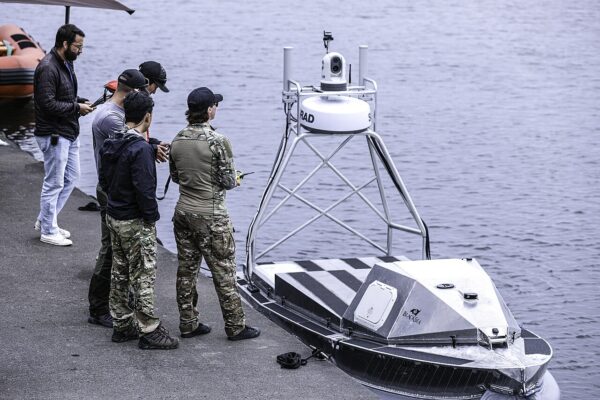
Two U.S. Army aviators were rescued Monday night after their AH-64 Apache helicopter went down near the strategically important Strait of Hormuz, with an unmanned Navy vessel playing a central role in locating and recovering the crew.
The rescue operation highlighted the growing use of artificial intelligence and autonomous systems in military operations, as U.S. forces worked to recover the service members from waters near the coast of Oman.
According to a statement provided Tuesday by U.S. Central Command spokesman Capt. Tim Hawkins, the two crew members were found and picked up by a Saronic Corsair, an unmanned surface vessel assigned to the Navy’s artificial intelligence and drone task force.
The sailors located the downed crew in waters off Oman and successfully brought them to safety. After being recovered, the two service members received assistance from U.S. personnel on land and were transported for medical evaluation.
Officials said both crew members are in stable condition and continue to receive medical care.
The unmanned vessel involved in the rescue is part of a broader initiative that has increasingly incorporated artificial intelligence and robotic technology into military operations throughout the Central Command region. According to Hawkins, these drone systems began operating in the region in late March.
Central Command said the rescue effort involved a coordinated response led by U.S. Naval Forces Central Command and the Army’s 82nd Airborne Division. Additional support was provided by Air Force and Navy assets, including the U.S. Fifth Fleet’s Task Force 59.
Task Force 59 was established in 2021 as the Navy’s first unit dedicated specifically to unmanned systems and artificial intelligence. Based in Bahrain, the task force focuses on integrating advanced robotic technologies into maritime operations across the Middle East.
The rescue mission quickly drew attention in Washington after President Donald Trump stated Tuesday that Iran was responsible for bringing down the helicopter.
In a post on Truth Social, Trump said Iran had shot down the aircraft and vowed that the United States would respond.
“Nevertheless, the United States must, of necessity, respond to this attack,” the president wrote.
Later Tuesday, Trump offered a brief update on the condition of the crew while speaking with reporters after attending Game 3 of the NBA Finals.
“Nobody injured,” the president said. “We are going to issue a report tomorrow. But the pilots are fine.”
The Apache helicopter plays a significant role in ongoing U.S. operations in the Strait of Hormuz, where American forces are participating in a naval blockade intended to prevent ships carrying Iranian crude oil from moving through the critical waterway.
The incident serves as another reminder of the risks facing American service members operating in one of the world’s most strategically sensitive regions. Even as advances in unmanned technology continue to reshape military operations, the dangers associated with conflict in and around the Persian Gulf remain ever-present.
Monday’s rescue marked the second publicly known recovery of U.S. personnel during the ongoing conflict with Iran.
In April, two crew members aboard an F-15E Strike Eagle were rescued after Iranian forces shot down the aircraft with an anti-aircraft missile.
While both incidents ended with successful recoveries, they underscore the continuing hazards that accompany military operations in contested regions, where escalating confrontations can place American personnel in harm’s way with little warning.
[READ MORE: Former Platner Aide Issues Scathing Rebuke Ahead of Maine Democratic Primary]