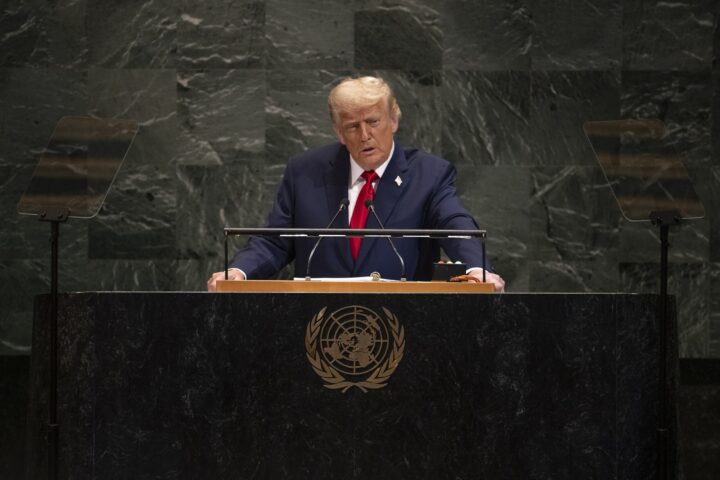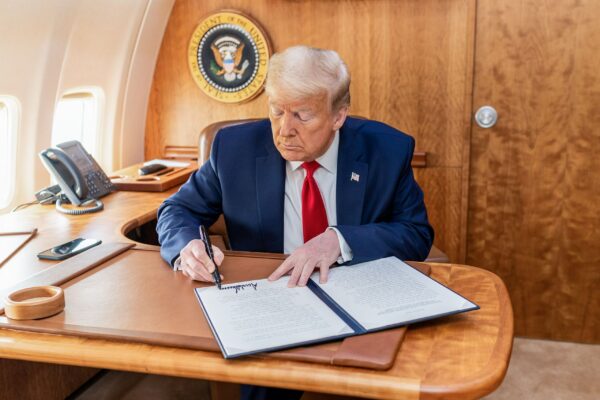
President Donald Trump announced Friday that he is prepared to impose nationwide voter identification requirements for the 2026 midterm elections through executive action if Congress fails to deliver legislation mandating such standards.
In a series of posts on Truth Social, the president made clear he intends to move forward regardless of the bill’s fate on Capitol Hill.
“If we can’t get it through Congress, there are Legal reasons why this SCAM is not permitted. I will be presenting them shortly, in the form of an Executive Order,” Trump wrote in one post. In a follow-up message, he added: “There will be Voter I.D. for the Midterm Elections, whether approved by Congress or not!”
The announcement comes just days after the House of Representatives narrowly approved the Safeguard American Voter Eligibility (SAVE) America Act in a 218–213 vote. The measure, backed unanimously by Republicans and joined by a single Democrat, Rep. Henry Cuellar of Texas, would require documentary proof of U.S. citizenship—such as a passport or birth certificate—when registering to vote in federal elections. It would also mandate photo identification at polling locations.
The legislation now heads to the Senate, where its prospects remain uncertain. Although Republicans hold a 53-seat majority, advancing the bill would likely require 60 votes to overcome a Democratic filibuster. Sen. Lisa Murkowski of Alaska has publicly opposed the measure, complicating the path forward, but at least 50 Republicans have backed the bill.
Trump’s suggestion that he may act unilaterally revives a legal fight that surfaced during his first year back in office, according to The Daily Caller. In 2025, U.S. District Judge Colleen Kollar-Kotelly struck down portions of a prior Trump executive order aimed at tightening election procedures. The court held that the Constitution assigns primary authority over election regulation to Congress and the states, and that the president lacks statutory authority to impose such changes independently.
Whether a new executive order would survive judicial scrutiny remains unclear. The White House has not yet released details of the proposed directive or the specific legal rationale Trump says would justify bypassing Congress.
Public opinion, however, continues to tilt strongly in favor of voter identification requirements. A Pew Research Center survey conducted in August 2025 found that 83 percent of Americans support requiring government-issued photo identification to vote. The backing spans partisan lines, with 95 percent of Republicans, 71 percent of Democrats, and 84 percent of independents expressing support.
Supporters of voter ID laws argue that such measures strengthen election integrity and bolster public confidence in the system. Critics contend they risk creating unnecessary barriers for eligible voters, particularly those who may lack easy access to documentation.
With the November midterms approaching, Trump’s announcement ensures that the debate over election security—and executive power—will remain at the forefront of national politics.