President Donald Trump on Thursday took aim at California Gov. Gavin Newsom, claiming the Democrat had effectively removed himself from contention for a potential 2028 presidential run based on comments about his own learning challenges.
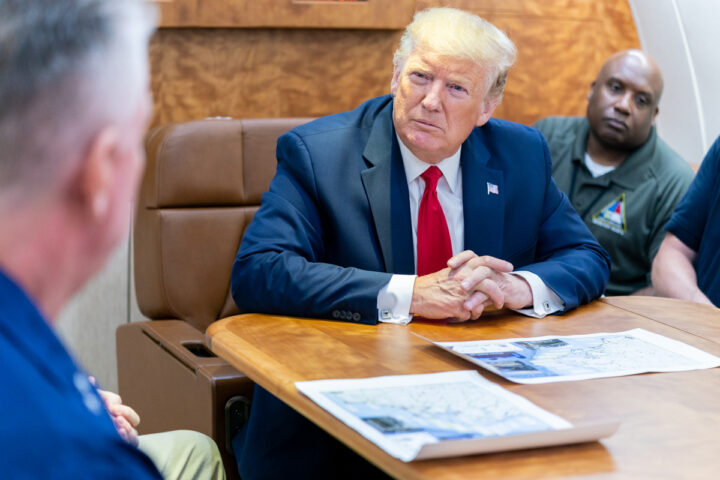
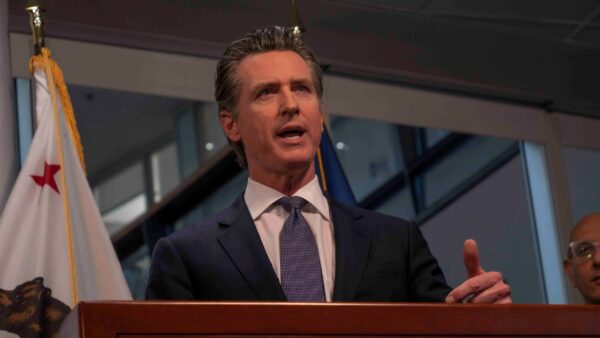
Speaking during a Cabinet meeting at the White House, Trump asserted that Newsom “took himself out of the running” after what the president characterized as an admission of having a “mental disability.” The remarks quickly drew attention, as Newsom has publicly discussed living with dyslexia—a condition widely understood not as a mental illness, but as a learning difference.
According to the Cleveland Clinic, dyslexia is a “common, life-long neurodevelopmental learning difference” that affects how the brain processes language, reading, and spelling. The clinic emphasizes that it is not a disease, does not reflect intelligence, and is not caused by poor instruction.
Despite that distinction, Trump continued to press his criticism, saying he would not want “a person with mental disability” serving as president. During the exchange, laughter could be heard in the background as the president dismissed concerns raised by a reporter who had suggested such comments were inappropriate.
“I have no problem with it,” Trump said, doubling down on his position. He went on to argue that voters would not want a president who struggles in such ways, claiming that Newsom “can’t read a speech” and “can’t do almost anything.”
The president escalated his rhetoric further, calling Newsom “a very stupid person” and suggesting that the governor’s own statements amounted to an admission that disqualifies him from higher office. Trump framed the issue as one of competence and leadership, positioning himself as a contrast.
In that vein, Trump pivoted to highlighting his own cognitive abilities, repeating a familiar claim that he has taken and excelled on multiple cognitive tests. According to the president, he has completed the test three times and “aced” each attempt in front of doctors.
He described the exam as increasingly difficult, beginning with simple questions and progressing to more challenging ones, including mathematical problems. Trump said he had been warned ahead of time that poor performance could become public, particularly given that the testing took place at Walter Reed National Military Medical Center, which he described as “essentially a public hospital.”
Nevertheless, Trump maintained that he answered every question correctly. He added that one doctor told him they had never seen a perfect score in two decades of administering the test. The president also renewed his call for other national leaders—including presidents and vice presidents—to undergo similar evaluations.
The exchange highlights the increasingly personal tone of political discourse as attention begins to turn toward future elections. While Trump framed the issue as one of fitness for office, the debate also underscores a broader question about how health, ability, and leadership are discussed in the public arena.
As political tensions continue to rise, moments like these serve as a reminder that sharp rhetoric can dominate headlines—even as more substantive issues, including matters of governance and conflict abroad, continue to unfold in the background.
[READ MORE: Iran Fortifies Kharg Island as U.S. Weighs Potential Military Move]