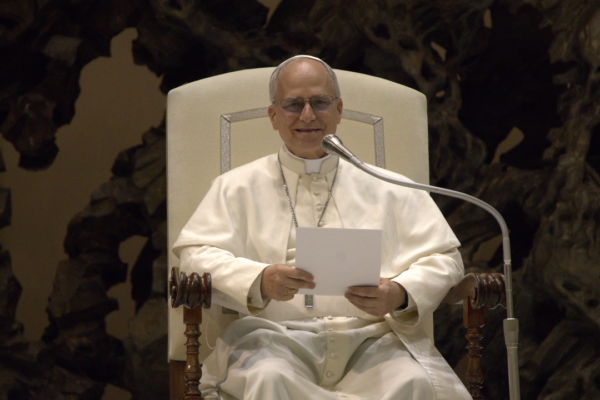
President Donald Trump reportedly made clear Monday that he has no intention of backing down from his sharp criticism of Pope Leo XIV, underscoring a widening rift between political leadership and religious authority over issues of war, crime, and global security.
Speaking to reporters outside the White House, Trump was asked directly whether he planned to apologize for a fiery social media post in which he described the pope as “weak.” His response was blunt: no. The president instead doubled down, arguing that the pontiff was “wrong” in his stance on Iran and the broader conflict.
“You cannot have a nuclear Iran,” Trump said, warning of catastrophic consequences if such a scenario were allowed to unfold. He insisted that preventing that outcome remains non-negotiable, adding that the scale of potential loss of life would be immense. “It’s not going to happen,” he said, dismissing any suggestion that his rhetoric had gone too far.
Trump framed his earlier remarks as a direct response to criticism from Pope Leo, who in recent days has spoken out forcefully against the ongoing Iran war. The pope condemned threats to destroy an entire civilization as “truly unacceptable” and later reiterated his opposition to the conflict, stating that “God does not bless any conflict.” His message struck a moral tone that contrasted sharply with the administration’s more hardline posture.
For Trump, however, the disagreement appears rooted in what he sees as a failure to confront both crime and international threats with sufficient resolve. He reiterated his view that the pope’s positions reflect weakness, not strength, and suggested that a more pragmatic, “common sense” approach would better serve global stability.
The president also drew a contrast within the pope’s own family, praising his brother, Louis Prevost, as someone he aligns with more closely, describing him as supportive of the MAGA movement. The remark added a personal dimension to what is already a deeply ideological clash.
Trump’s criticism was not limited to Iran. In his earlier comments, he also took aim at the pope’s views on crime and pandemic-related issues, characterizing them as misguided. He suggested that the pontiff’s perspective leans too heavily toward political considerations rather than practical outcomes.
Despite the intensity of the president’s remarks, Pope Leo appeared unmoved. Responding Monday, he said he has no fear of speaking out, emphasizing his responsibility to deliver the message of the Gospel regardless of political pressure. His statement signaled a willingness to continue addressing moral concerns tied to the war, even in the face of direct criticism from the White House.
The exchange highlights a broader tension that often emerges in times of conflict: the balance between moral caution and strategic resolve. While political leaders focus on preventing perceived threats, voices like the pope’s serve as a reminder of the human cost that can accompany such decisions.
As the debate continues, the sharp back-and-forth underscores not only a personal disagreement, but a deeper divide over how best to navigate a dangerous world—one where the consequences of action, or inaction, can be measured not just in policy wins, but in lives potentially lost.