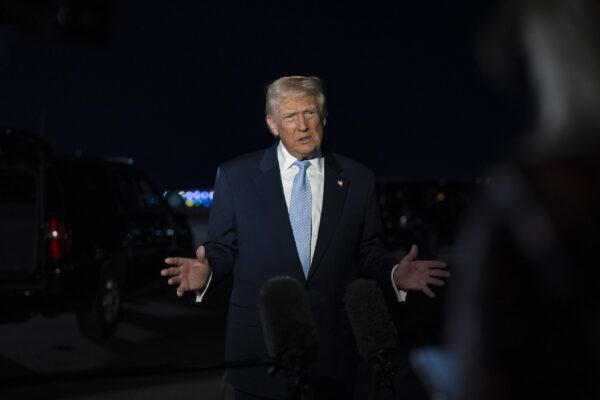
President Donald Trump said Thursday that Chinese President Xi Jinping would ultimately have to decide for himself whether to use military force against Taiwan, while making clear he has warned Beijing against such a move and believes it will not happen while he is in office.
Speaking to The New York Times, Trump said Xi views Taiwan as part of China and emphasized that any decision on military action rests with the Chinese leader. “Xi considers Taiwan to be a part of China and that’s up to him what he’s going to be doing,” Trump said, adding that he has personally expressed his opposition to the use of force.
“You know, I’ve expressed to him that I would be very unhappy if he did that and I don’t think he’ll do that. I hope he doesn’t,” Trump said, days after the United States captured Venezuelan leader Nicolás Maduro.
Trump went on to suggest that his presence in the White House is a key factor restraining Beijing. “He may do it after we have a different president, but I don’t think he’s going to do it with me as president,” Trump said.
The president contrasted the situation involving China and Taiwan with the circumstances that led to U.S. military action against Venezuela. Trump said Maduro’s capture followed signs of a “real threat” and argued that the challenges posed by Venezuela were fundamentally different from anything China is facing.
“You didn’t have people pouring into China. You didn’t have drugs pouring into China. You didn’t have all of the bad things that we’ve had,” Trump said. He added that there was no equivalent situation involving Taiwan, pointing out that there were not large numbers of people being released from jails or mental institutions and crossing borders.
“There aren’t that many people in the jails. But you didn’t have hundreds of thousands of people coming from jails and mental institutions,” Trump said.
The Trump administration has described its actions in Venezuela as part of a broader effort to combat the influx of illegal narcotics into the United States. Maduro, along with his wife, Cilia Flores, is facing narco-terrorism charges in the Southern District of New York, in addition to charges related to cocaine importation conspiracy and weapons offenses involving machine guns and destructive devices.
While the White House has defended U.S. military strikes on Caracas, Xi has overseen an increase in Chinese military activity near Taiwan. In recent weeks, Chinese officials have confirmed live-fire drills around the island, involving 130 aircraft, including fighters and bombers, as well as 14 military ships and eight additional official vessels from Beijing.
Lawmakers from both parties on the House Select Committee on the Chinese Communist Party condemned the show of force and reiterated Washington’s support for Taiwan. Committee Chair John Moolenaar and then-ranking member Raja Krishnamoorthi said the drills were designed to intimidate Taiwan and other democracies in the region and to undermine peace and stability across the Indo-Pacific.
They warned that by rehearsing coercive military scenarios and projecting power beyond its borders, the Chinese Communist Party is attempting to reshape the regional order through aggression and intimidation. The lawmakers stressed that the United States stands with Taiwan and other democratic partners and will continue working to preserve Taiwan’s security and maintain a free, open, and stable Indo-Pacific.
The White House did not immediately respond to a request for comment regarding Trump’s remarks about Xi, but the president’s comments underscored his view that strong leadership and direct warnings remain central to preventing conflict in one of the world’s most sensitive regions.
[READ MORE: White House Suspects Greene May Have Alerted Far-Left Protesters to Trump Dinner]