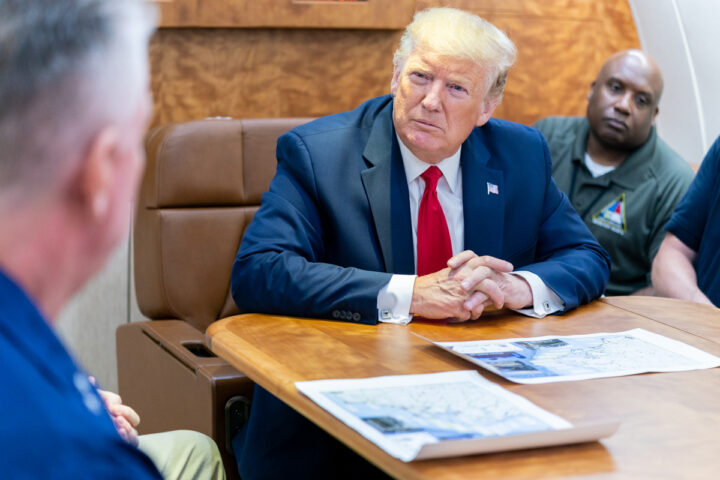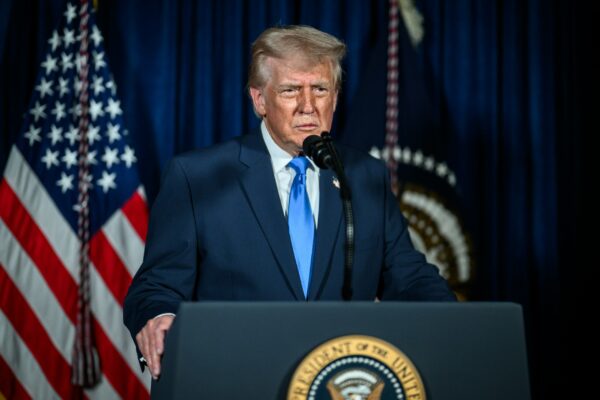
President Donald Trump said Friday that he will know when the U.S. military operation in Iran has reached its conclusion when he can “feel it in my bones,” offering a characteristically personal assessment of a conflict that began nearly two weeks ago with joint U.S. and Israeli strikes.
Trump made the remarks during an appearance on “The Brian Kilmeade Show,” a podcast hosted by Fox News personality Brian Kilmeade. The conversation focused on the timeline and outlook for the military campaign, which the president suggested could wrap up sooner rather than later.
“When it’s over –– and I don’t think it’s going to be long –– when it’s over, this is going to bounce back so fast,” Trump said during the interview.
Kilmeade pressed the president for clarity about how he would determine when the conflict had reached its end.
“When are you going to know when it’s over?” the host asked.
“When I feel it,” Trump responded. “When I feel it in my bones.”
Kilmeade then asked whether ending the operation would involve a joint decision with the president’s national security team. Trump answered by praising several members of his administration, highlighting what he described as a strong leadership group guiding the effort.
“I’ve got all good people,” Trump said. “We’ve got a great group.”
He specifically mentioned Joint Chiefs of Staff Chair Gen. Dan Caine, Defense Secretary Pete Hegseth, Secretary of State Marco Rubio and Vice President Vance.
Trump has offered several different timelines since the military campaign began, reflecting the uncertainty that often surrounds conflicts once they start. Two days after the initial strikes, the president suggested the operation might take “four to five weeks” or potentially longer.
Later, speaking at a House Republican retreat in Miami, Trump described the mission as something that had to be carried out but indicated that the end might be approaching.
“This was just an excursion into something that had to be done,” he said at the event. “We’re getting very close to finishing that too.”
Trump struck an even more confident tone in an interview with Axios on Wednesday, telling the outlet there was “nothing left” to bomb in Iran and claiming the United States was already “way ahead of the timetable.”
“Any time I want it to end, it will end,” the president said.
Later the same day, while addressing supporters at a rally in Kentucky, Trump declared that Washington had already achieved victory in Iran and suggested the conflict was effectively finished.
Yet outside Washington, the regional reaction has been far more complicated.
Countries across the Persian Gulf have called for the fighting to stop, even as many of them have faced retaliatory attacks from Iran during the ongoing hostilities. While those nations have expressed anger toward Tehran over the strikes, they have not rallied behind the joint U.S. and Israeli military operation launched by Trump and Israeli Prime Minister Benjamin Netanyahu.
Observers in the region say the mood among Gulf states reflects several overlapping concerns.
“The mood in the Gulf is three layers, first is rage against Iran, second is dismay with Washington, and third is profound suspicion about Israel’s regional agenda and profile,” Hussein Ibish, a senior resident scholar at the Arab Gulf States Institute in Washington, previously told The Hill.
Ibish said there is growing unease that the conflict may be reshaping perceptions of regional stability.
“There’s a real sense that Israel is on a rampage and completely out of control and has transformed itself from a net contributor to regional stability, to being one of the main sources of instability and security,” he said.
As the conflict moves toward an uncertain endpoint, Trump’s comments highlight the challenge leaders often face when navigating military operations abroad—balancing confidence in victory with the reality that wars rarely follow a simple timetable once they begin.