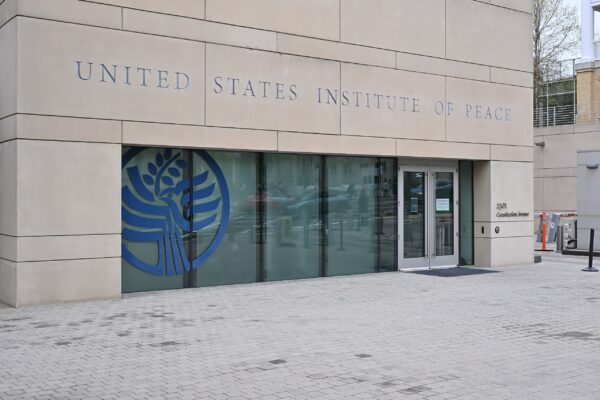
The State Department reportedly sparked new debate in Washington on Wednesday after announcing that the building housing the United States Institute of Peace now bears the name of President Donald Trump.
In a public statement, the department said it had renamed the structure to honor what it called “the greatest dealmaker in our nation’s history,” adding, “Welcome to the Donald J. Trump Institute of Peace. The best is yet to come.” According to eyewitnesses and images reported by The Washington Post, Trump’s name is now prominently displayed across multiple parts of the building long referred to as the Peace building.
The decision comes at a time when Trump has frequently highlighted his record on foreign affairs and his desire to be recognized on the global stage.
He has openly advocated for receiving the Nobel Peace Prize and claimed credit for ending several wars, even as his administration continues a series of military operations targeting alleged narcotics traffickers and so-called “narcoterrorists” in the Caribbean and Pacific regions.
During just the first five months of his second term, the United States conducted more than 500 bombings across Africa, the Middle East, and Central Asia—operations the administration argues are necessary to confront transnational threats.
The renaming also follows a prolonged confrontation between the Trump administration and the U.S. Institute of Peace itself. In February, Trump signed an executive order aimed at disbanding USIP, an organization created in 1984 by Congress and mandated to operate independently from the executive branch.
The administration’s newly created Department of Government Efficiency, led at the time by Elon Musk, moved to fire USIP employees and gain access to the organization’s computer systems after a tense standoff with staff.
That effort was halted by the courts. A federal judge ruled that the administration exceeded its authority by attempting to dissolve the congressionally established institute.
In a sharply worded decision, Judge Beryl Howell wrote that “outside of Article II, he has little constitutional authority to act at all,” and called the administration’s actions a “gross usurpation of power.”
Howell criticized the use of force and threats by federal and local law enforcement to gain control of the facility, saying the approach “unnecessarily traumatized” USIP leadership and staff. The ruling has been stayed pending appeal, leaving the future of the institute in legal limbo.
Critics of the renaming argue that affixing Trump’s name to the building amid ongoing litigation undermines the very independence Congress intended when it created USIP.
According to an attorney for former institute employees, the move “adds insult to injury,” especially for staff who were forcibly removed or displaced during the administration’s takeover attempt.
Supporters of the administration counter that the renaming reflects Trump’s broader commitment to reshaping U.S. foreign policy and elevating peace through strength.
Still, the move has deepened existing divisions in Washington over presidential authority, the role of independent institutions, and the future of America’s diplomatic posture. As the legal battle continues, the newly christened Donald J. Trump Institute of Peace stands as a symbol of the administration’s willingness to challenge long-standing norms—and its critics’ determination to push back.
[READ MORE: Rep. Anna Paulina Luna Moves to Force Vote on Congressional Stock Trading Ban, Bypassing GOP Leadership]