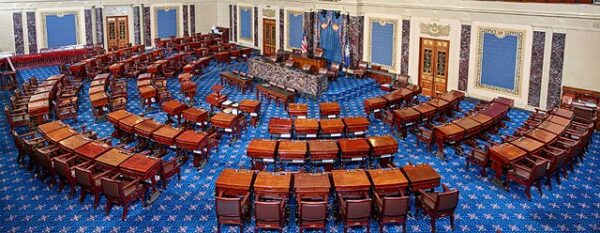
The Senate moved decisively Thursday to partially reopen the Department of Homeland Security, unanimously approving a funding bill that now heads back to the House as Washington attempts to bring an end to the longest partial government shutdown in U.S. history.
The measure represents a step forward after weeks of gridlock, though its ultimate fate remains uncertain. The House previously declined to take up the Senate’s approach, opting instead to pursue an alternative funding plan. Now, with a new agreement taking shape between congressional leaders, lawmakers appear poised to revisit the proposal.
Senate Majority Leader John Thune and House Speaker Mike Johnson announced a framework Wednesday aimed at breaking the impasse. Their plan outlines a two-step strategy: first, a partial reopening of the Department of Homeland Security, followed later this spring by a broader spending package that addresses unresolved policy disputes.
That larger package—often referred to as a “megabill”—is expected to include funding tied to President Donald Trump’s immigration and border priorities, which have been at the center of the standoff. Those issues have proven to be a key sticking point in negotiations, reflecting deeper disagreements over how to approach border security and enforcement.
For now, the Senate’s unanimous vote signals rare bipartisan agreement on at least part of the path forward. By focusing on reopening a critical agency first, lawmakers appear to be trying to separate immediate operational concerns from longer-term policy debates.
Still, questions remain about timing. It is unclear when the House will bring the Senate-passed bill to the floor for a vote. Members of Congress are currently on a two-week recess, though brief “pro forma” sessions have continued in Washington to keep legislative business technically active.
The ongoing shutdown has underscored the challenges of governing during periods of sharp political division. While both parties have expressed a desire to restore funding, the details of how and under what conditions have delayed progress, leaving key government functions in limbo.
The two-step plan put forward by Thune and Johnson suggests a recognition that a comprehensive agreement may take more time—and that reopening parts of the government in the interim could ease pressure on federal workers and the public. At the same time, it effectively postpones the most contentious debates, setting the stage for another round of negotiations in the months ahead.
For supporters of the administration’s approach, tying future funding to immigration priorities is seen as a necessary step to address ongoing concerns at the border. Critics, however, have argued that linking agency funding to broader policy demands risks prolonging disruptions.
As the bill returns to the House, lawmakers face a familiar challenge: balancing immediate needs with long-term goals in a way that can command enough support to move forward. The Senate’s unanimous vote may offer momentum, but until both chambers align, the shutdown will remain a stark reminder of how difficult it can be to translate agreement in principle into action.
Even as progress appears within reach, the path to a full resolution is not yet complete—leaving Washington once again navigating the delicate line between compromise and stalemate.