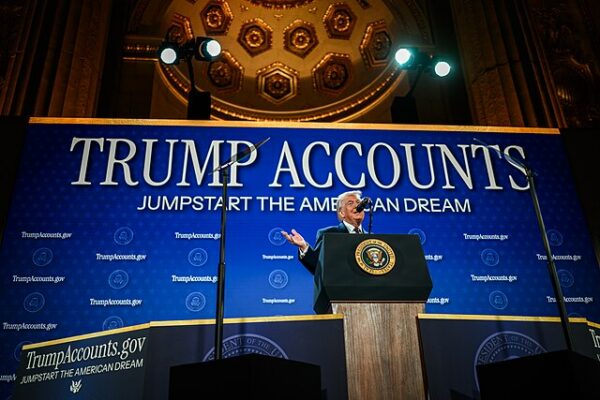
The U.S. Department of the Treasury has tapped Bank of New York Mellon to serve as the official financial agent for a new tax-advantaged savings initiative known as “Trump accounts,” a program designed to help families build long-term assets for their children.
Officials announced the partnership Monday, noting that BNY Mellon will work alongside Robinhood to develop a dedicated mobile platform intended to streamline enrollment, contributions, and account management. The announcement was made during an appearance on CNBC’s Squawk on the Street, signaling a coordinated push to bring the program online ahead of its planned summer launch, according to CNBC.
The accounts are scheduled to go live on July 4 and will target families with children born between 2025 and 2028. Under the program, eligible participants will receive a one-time $1,000 seed contribution from the Treasury Department, with the aim of encouraging early and sustained saving.
BNY Mellon will oversee the program’s financial infrastructure, including custody and administration of funds. The bank has also indicated that it will match the federal government’s initial contribution for children of its U.S.-based employees, part of a broader effort to encourage private-sector participation. Additional employers have reportedly signaled similar interest, suggesting the program could evolve into a hybrid public-private savings model.
Robinhood, meanwhile, is expected to handle the user-facing technology. The company will build and maintain the app through which families can open accounts, track balances, and make contributions. The move reflects a growing reliance on fintech platforms to deliver government-linked financial services in a more accessible format.
Program participation has already accelerated during its early enrollment phase. According to Internal Revenue Service data, more than 4 million children had been registered for the accounts as of March 31. Of those, over 1 million qualified for the initial $1,000 government contribution under a pilot phase.
Enrollment is tied to the federal tax filing process. Families can opt in by submitting a simplified form alongside their 2025 tax returns or by registering through a dedicated website. Treasury and IRS officials have emphasized ease of access, framing the program as a low-barrier entry point into long-term saving.
Beyond the initial government deposit, the accounts allow for ongoing contributions. Parents, guardians, and other contributors may add up to $5,000 annually in after-tax dollars. Employers are permitted to contribute up to $2,500 per year on a pre-tax basis for employees’ children, with those contributions counting toward the overall annual cap. The contribution limits are expected to rise with inflation beginning after 2027.
Philanthropic groups have also begun pledging supplemental funding in certain states, potentially expanding the program’s reach among lower-income families.
An authentication process is slated to begin in May, with the first round of government-funded deposits expected to land in accounts on July 4. Treasury officials have framed the timeline as both symbolic and practical—linking the launch to Independence Day while ensuring the infrastructure is in place ahead of broader adoption.
The collaboration between a legacy financial institution and a fintech platform underscores a broader shift in how public programs are administered, blending traditional banking oversight with app-based delivery systems. If uptake continues at its current pace, Trump accounts could become one of the more widely adopted savings initiatives tied to federal tax policy in recent years.