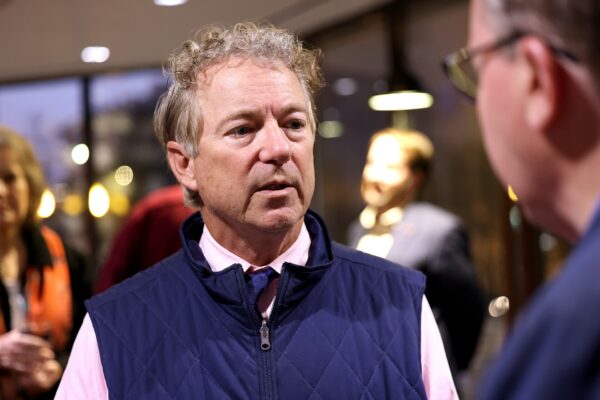
Sen. Rand Paul, R-Ky., is pushing back against President Donald Trump’s call for Republicans to “take over” voting procedures in multiple states and to “nationalize” elections, arguing that such a move would violate the Constitution and undermine the system of federalism that governs U.S. elections.
In an interview Tuesday with MS NOW host Stephanie Ruhle, Paul said Trump’s proposal runs directly counter to what the Constitution allows when it comes to election administration. While acknowledging that the federal government and the Supreme Court do impose certain uniform standards, Paul said the core authority over elections clearly rests with the states.
“That’s not what the Constitution says about elections,” Paul said when asked about Trump’s remarks. He explained that while the Supreme Court has ruled states cannot set different rules in some areas — such as imposing term limits on federal officials — the Constitution otherwise grants states wide latitude.
“The Supreme Court did rule that, for example, Washington state can’t set term limits on federal officials if Georgia doesn’t. It has to be a uniform election law,” Paul said. “But as far as the time, place and manner of elections, that, under the Constitution, is a state activity.”
Because of that, Paul said he cannot support any effort to nationalize elections, regardless of which party proposes it.
“So, I’m not for nationalizing it,” he said.
Paul also noted that Democrats attempted to push sweeping national election reforms during President Joe Biden’s time in office, efforts that Republicans successfully blocked in the Senate. He made clear that his opposition is consistent and not dependent on who occupies the White House.
“I was against [former Speaker] Nancy Pelosi’s bill, which would have nationalized it, but I would also be against any bill coming from this administration that would nationalize elections,” Paul said.
Trump, however, doubled down Tuesday on his call for a more centralized federal role in elections, despite attempts by the White House to soften his earlier comments. The president argued that federal involvement is necessary to combat what he described as corruption in certain jurisdictions.
“Look at some of the places — that horrible corruption on elections — and the federal government should not allow that,” Trump said. “The federal government should get involved.”
Those comments followed remarks Trump made during a podcast interview with conservative commentator and former Deputy FBI Director Dan Bongino that aired Monday. In that appearance, Trump said Republicans should actively seize control of election administration in a number of states.
“The Republicans should say, ‘We want to take over,’” Trump said. “We should take over the voting, the voting in at least many — 15 places. The Republicans ought to nationalize the voting.”
Trump’s remarks sparked immediate pushback from several prominent Republican lawmakers, including Senate Majority Leader John Thune of South Dakota. Thune emphasized his support for voter identification requirements but drew a firm line against federalizing elections.
“I’m supportive of only citizens voting and showing ID at polling places,” Thune said. “I think that makes sense. … But I’m not favor of federalizing elections, no. I think that’s a constitutional issue.”
Thune added that decentralization has long been a strength of the American election system.
“I’m a big believer in decentralized and distributed power,” he said. “And I think it’s harder to hack 50 election systems than it is to hack one. In my view, at least, that’s always a system that has worked pretty well.”
The debate highlights a rare public split among Republicans, as concerns about election integrity collide with constitutional limits on federal power.
[READ MORE: Rand Paul Comes Out Against Trump On Voter ID]