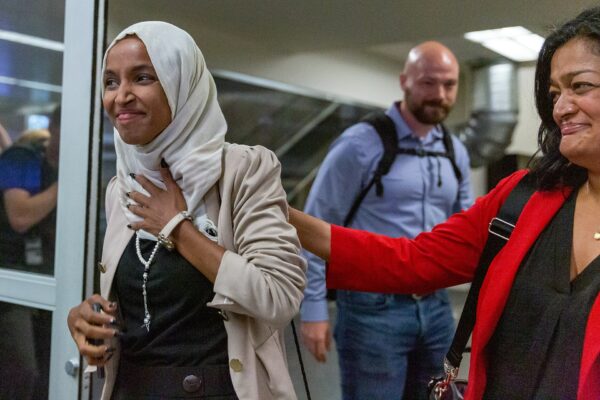
Rep. Ilhan Omar on Wednesday blamed President Donald Trump for the attack she faced at a Minnesota town hall, telling reporters that his rhetoric has fueled threats against her and the community she represents.
Omar made the comments a day after she was confronted at a public event where a man rushed toward her and sprayed her with an unidentified liquid while she was speaking to supporters. The incident prompted heightened security concerns and quickly drew national attention.
At a news conference the following day, Omar said she believes the alleged attacker was motivated by frustration over immigration policy. She claimed that the man, identified by authorities as Anthony Kazmierczak, was angered that Trump’s order to deport Somalis had not resulted in what he viewed as sufficient deportations.
According to Omar, the suspect believed she was standing in the way of those efforts. “He was upset that Trump’s order to deport Somalis was not yielding enough deportations of Somalis, so he wanted to come get the person he thought was protecting the Somalis,” she said.
Omar went further, directly tying the attack to the president’s public comments about her. She told reporters that whenever Trump speaks critically about her, the level of threats she receives increases dramatically.
“Every time the president of the United States has chosen to use hateful rhetoric to talk about me and the community that I represent, my death threats skyrocket,” Omar said.
She argued that Trump’s fixation on her has forced her to take extraordinary security measures. Omar said she now has to pay for protection and has required discussions with the government about providing security, something she claimed would not have been necessary if Trump were not in office.
“I wouldn’t be where I am at today, having to pay for security, having the government to think about providing me security if Donald Trump wasn’t in office and if he wasn’t so obsessed with me,” Omar said.
She also pointed to the timing of Trump’s remarks, noting that he had mentioned her publicly shortly before the attack occurred. Omar described it as ironic that Trump discussed her on stage just moments before the incident and then later downplayed her significance when asked about the attack.
“It is ironic that just last night he was on stage moments before I was attacked talking about me, and then when asked about my attack, he said, ‘I don’t think about her,’” she said.
Authorities have not confirmed any motive behind the attack. The FBI assumed control of the investigation on Wednesday, but neither federal investigators nor the Minneapolis Police Department have commented publicly on what may have driven the incident. Law enforcement officials have also not verified Omar’s claims about the attacker’s motivations.
The lack of official findings has not stopped Omar from drawing conclusions about the broader political climate. She framed the attack as part of a larger pattern, arguing that political rhetoric has real-world consequences for elected officials who are frequent targets of criticism.
The incident remains under investigation as authorities work to determine whether the attack was planned and what prompted it. For now, Omar continues to insist that Trump’s words have played a central role in the threats she faces, while investigators have yet to release any evidence supporting or contradicting her claims.
As the probe moves forward, the case is likely to intensify debate over political rhetoric, personal security for lawmakers, and how much responsibility national leaders bear for the actions of individuals who target public officials.