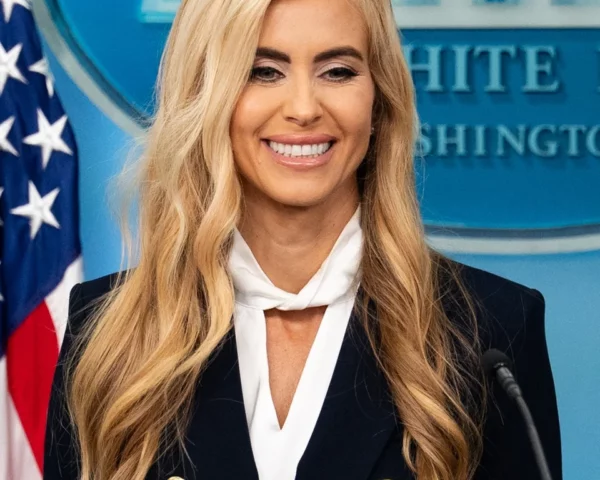
White House press secretary Karoline Leavitt previewed President Donald Trump’s speech ahead of the rescheduled White House Correspondents’ Dinner on Friday, promising a speech that would blend sharp political jabs with moments of unity.
Speaking before the event, Leavitt described the president’s upcoming remarks as striking a balance between humor, seriousness and his trademark style.
“The President’s speech will be a combination of unifying yet vicious, and serious yet hilarious, all at the same time, if you can imagine that,” Leavitt said. “One thing I can assure you, it will be entertaining.”
The White House Correspondents’ Dinner had originally been scheduled for April but was postponed after a gunman opened fire in the lobby of the Washington Hilton.
CNN aired remarks Trump made after the April event was canceled, in which the president acknowledged he had planned a far more aggressive speech before deciding the timing would have been inappropriate following the shooting.
“I was all set to really rip it, and I said to my people, this would be the most inappropriate speech ever made if I said so, I’ll have to save it,” Trump said.
The president added that he was uncertain whether he would ever deliver the speech as originally planned.
“I don’t know if I could ever be as rough as I was going to be tonight. I think I’m going to be probably very nice. I’ll be very boring the next time,” Trump said.
Leavitt’s latest comments, however, suggested Friday’s address would include both conciliatory remarks and pointed criticism.
CNN anchor Jim Sciutto questioned how those two approaches could coexist as he introduced media reporter Brian Stelter.
“But today’s new official White House preview, a quote ‘combination of unifying, yet vicious,’” Sciutto said. “I mean, can you be unifying and vicious? I don’t get it.”
Stelter responded by expressing skepticism that such a combination was possible.
“I’ve never heard a speech where someone’s unifying and vicious. But maybe we will tonight,” he said.
Stelter argued that the relationship between Trump and the media makes a broadly conciliatory tone unlikely.
“This is definitely not going to be a ‘kumbaya moment,’ though. There’s no way it can be, because the tension is inescapable,” Stelter said.
He described what he characterized as an ongoing conflict between the president and the press, saying it has become even more pronounced during Trump’s second administration.
“The push and pull between the president and the press. It’s always there, but it’s, of course, much more heightened during Trump 2.0,” Stelter said.
He added, “This is a president who wants attention but rejects accountability. And so it always goes downhill in one way or another.”
Stelter also reflected on Trump’s response following the April shooting at the Washington Hilton, arguing that any period of unity was brief.
“Back in April, the president was briefly unifying after that shooting attempt,” Stelter said. “But the next day he tore into CBS correspondent Norah O’Donnell and called the press ‘terrible people,’ so that unifying moment lasted less than 24 hours. I don’t expect anything different this time around.”
During the segment, Stelter also pointed to what he described as actions taken by the Trump administration against news organizations, including challenges by the Federal Communications Commission involving station licenses and investigations into media companies.
Despite those developments, Stelter maintained that journalism would continue.
“American journalism is stronger than any demagogue,” he said. “The journalists keep working. The press is out there doing the work every day.”
At the same time, he argued that the news industry has been affected by subpoenas, funding reductions, license challenges and what he described as an atmosphere of intimidation.
According to Stelter, that broader environment has led some outside critics to argue that the White House Correspondents’ Dinner should not have taken place this year or that Trump should not have been invited to attend.
With expectations running high, Leavitt indicated that Trump’s remarks would feature both sharp rhetoric and humor, while critics continued to question whether the event could produce any genuine moment of unity between the president and the press.
[READ MORE: CNN’s Harry Enten Says Public Opinion on Israel Has Shifted Dramatically as Favorability Falls]