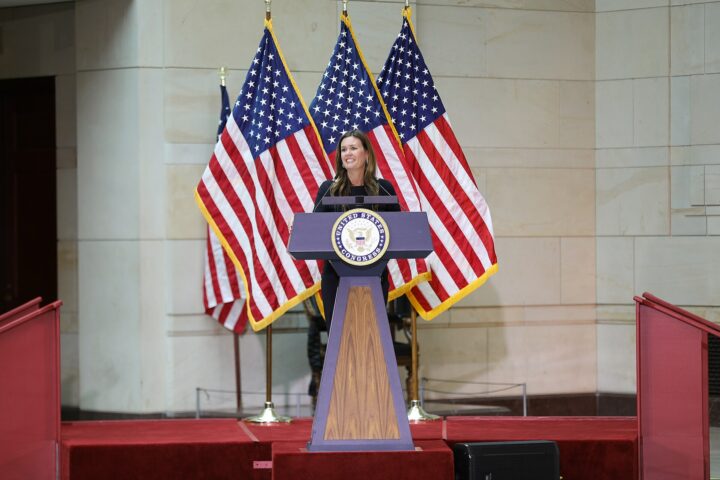
White House Press Secretary Karoline Leavitt is facing criticism after a social media post touting what she described as overwhelming American support for Operation Epic Fury drew a corrective community note and sharp pushback online.
In a Thursday post on X, Leavitt declared, “Americans Agree that Operation Epic Fury Is an Overwhelming Success,” linking to a White House page meant to bolster that claim. But the data she cited told a more complicated story—one that critics say undercuts the sweeping assertion.
The page highlighted six polls showing support levels between 80 and 90 percent for the military campaign against Iran. However, those figures applied specifically to MAGA-aligned Republicans or Republicans broadly, not the American public as a whole. That distinction quickly became the focal point of the controversy.
Other polling included in the same materials painted a less uniform picture. A Washington Post survey found a plurality of Americans backing U.S. action against Iran, with approval increasing as military successes were reported. At the same time, the poll indicated that many Americans would still prefer for the conflict to come to an end—suggesting support that may be conditional or cautious rather than enthusiastic.
Additional polls cited by the White House added further nuance. A Rasmussen survey found that 61 percent of respondents considered Operation Epic Fury successful, while a Fox News poll showed that six in 10 Americans view Iran as a threat to the United States. While those figures point to concern about Iran and some approval of the operation, they fall short of demonstrating the kind of overwhelming consensus Leavitt described.
X users were quick to flag the discrepancy. A community note attached to Leavitt’s post pointed out that the polling she referenced focused primarily on Republican respondents, excluding Democrats and Independents. According to the note, this selective framing “skews the data and misrepresents America’s views as a whole.”
Critics seized on the clarification. Commentator Mehdi Hasan accused Leavitt of misrepresenting her own source, writing that her post relied on data showing support largely within a specific political base while claiming it reflected the broader public.
Despite the backlash, Leavitt appeared to stand by her position. In a follow-up post on Friday, she shared a Politico poll breaking down support levels more explicitly: 81 percent among MAGA Republicans, 61 percent among non-MAGA Republicans, and 43 percent overall.
Even with those broader numbers, Leavitt maintained that public confidence in President Donald Trump remains strong. “As I’ve said repeatedly, Americans trust President Trump as their Commander-in-Chief and support his efforts to eliminate terrorist threats and keep us safe,” she wrote, dismissing suggestions of division within the Republican base.
The episode highlights a familiar tension in wartime politics: strong support within certain constituencies can coexist with more measured or uncertain sentiment across the wider public. While many Americans may view Iran as a legitimate threat and express backing for military action in principle, the available polling also suggests hesitation—particularly when it comes to the duration and broader consequences of such conflicts.
As debate continues, the numbers themselves offer a reminder that public opinion on war is rarely as unified as political messaging might suggest.
[READ MORE: Comey Called To Testify To Grand Jury]