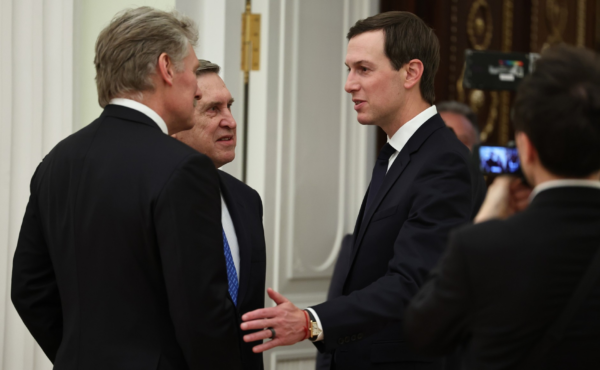
Jared Kushner, son-in-law to President Donald Trump, is facing renewed scrutiny as reports indicate he is actively seeking billions in investment for his private equity firm while simultaneously serving in a high-profile diplomatic role for the administration.
Kushner, who is married to Ivanka Trump, was appointed in February 2026 to an unofficial position as the administration’s “special peace envoy,” placing him at the center of negotiations in regions including the Middle East. At the same time, according to reporting from The New York Times, Kushner has been working to raise at least $5 billion for his firm, Affinity Partners.
The outlet cited five individuals familiar with the matter, all of whom said Kushner has been meeting with potential investors as part of that effort. Those discussions reportedly include outreach to governments in the Middle East, a region where Kushner is also engaged in sensitive diplomatic work.
Axios, confirming the reporting, noted that Kushner and his team have entered into talks with Saudi Arabia’s Public Investment Fund for potential “first look” investment rights. The fund, overseen by Crown Prince Mohammed bin Salman, serves as the kingdom’s primary sovereign wealth vehicle and is largely backed by oil revenues.
The overlap between Kushner’s diplomatic responsibilities and his business pursuits has raised questions about the boundaries between public service and private financial interests. The New York Times described the situation as a “blurring of the lines between public service and private profit-seeking,” a concern that has followed Kushner since his earlier tenure in government.
Kushner’s firm already has financial ties to Saudi Arabia. Shortly after the first Trump administration, the Public Investment Fund committed $2 billion to Affinity Partners. At the time, there were reports that some members of the fund’s investment team had reservations about the deal, though Crown Prince Mohammed bin Salman ultimately approved it.
The close relationship between the Trump administration and Saudi leadership has also been a defining feature of this dynamic. In November 2025, when asked about the 2018 killing of Washington Post columnist Jamal Khashoggi inside the Saudi consulate in Istanbul, President Trump defended the crown prince.
“You’re mentioning somebody that was extremely controversial,” Trump said at the time. “A lot of people didn’t like that gentleman that you’re talking about. Whether you like him or didn’t like him, things happen, but he knew nothing about it.”
Kushner’s fundraising efforts are not limited to Saudi Arabia. In a December 2024 podcast interview, he explained that Affinity Partners had “preemptively” secured $1.5 billion from Qatar’s sovereign wealth fund. He said the move was designed to avoid conflicts and ensure the firm would not need to raise additional capital for several years.
Now, however, as Kushner continues to engage in negotiations abroad, the reported push to secure billions more in funding is drawing heightened attention.
The situation highlights a broader tension that can arise when diplomacy, finance, and geopolitics intersect. While advocates may argue that relationships built through global engagement can open doors, critics warn that such overlap risks complicating already delicate negotiations—particularly in regions shaped by ongoing conflict and competing interests.
As Kushner continues to operate in both spheres, the questions surrounding those dual roles are unlikely to fade, especially at a time when decisions made abroad can carry significant and lasting consequences.
[READ MORE: Russia Backs Cuba as Tensions Rise Following Trump Remarks]