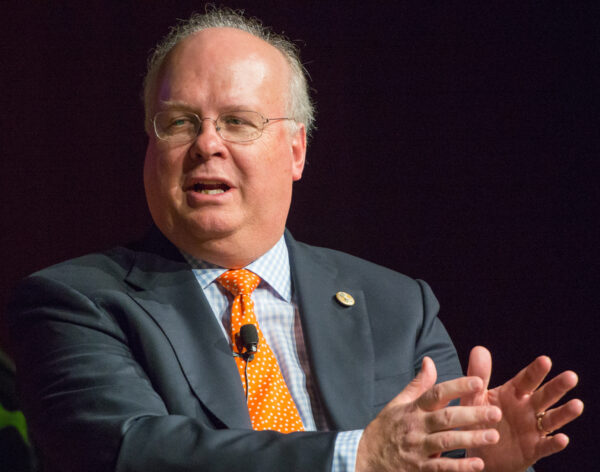
Fox News contributor Karl Rove pushed back Tuesday on Democratic hopes of flipping more than 40 Republican-held House seats this November, arguing that such expectations are likely out of reach given the current political climate.
Appearing on America’s Newsroom, Rove weighed in on a new report suggesting Democrats are expanding their battlefield map, now targeting dozens of GOP incumbents as they look to reclaim control of the House. The discussion also touched on remarks from Hakeem Jeffries, who has floated the possibility of redrawing New York’s congressional districts in a way that could benefit Democrats.
Rove, a longtime Republican strategist, dismissed the idea that meaningful redistricting changes could be implemented in New York ahead of the midterm elections. He then turned his attention to what he described as overly ambitious Democratic projections.
“You mentioned something, the Democrats are now targeting 40 House Republican seats,” Rove said. “They just added, I think it was eight, to their list. Now, I think that’s a stretch.”
According to Rove, it’s not unusual for political parties to cast a wide net heading into an election cycle, identifying far more potential pickup opportunities than are realistically achievable. In his view, Democrats are banking on favorable political winds that may or may not materialize.
“Every party going into an election has more targets than it actually has real good opportunities,” he explained. “They’re hoping that something swings their way.”
Still, Rove acknowledged that shifts in momentum are always possible. But he emphasized that several structural factors—including existing district boundaries and a deeply divided electorate—are likely to limit the scale of any electoral shakeup.
He pointed to what he described as an unusual political environment, where both major parties face challenges with voter sentiment. While President Donald Trump remains unpopular, Rove noted that the Democratic Party is also struggling to gain broad support.
Citing a recent Harris survey, Rove highlighted that the generic congressional ballot is essentially tied, with Republicans and Democrats each at 50 percent. That kind of evenly split landscape, he argued, typically results in only modest changes in congressional control rather than sweeping victories for either side.
Under those conditions, the number of truly competitive districts shrinks considerably. Rove suggested that the most vulnerable seats are those where voters have already shown a willingness to split their tickets—districts won by one party’s presidential candidate but represented by a member of the other party in Congress.
“That’s much smaller than forty seats,” he said. “It’s probably less than twenty seats.”
The remarks underscore a broader reality about modern American politics: sharp polarization has made large electoral swings increasingly rare. With districts often drawn to favor one party or the other, and voters more firmly entrenched in their political preferences, the battlefield for control of Congress has narrowed.
At the same time, the ongoing focus on redistricting battles—whether in Florida, New York, or elsewhere—highlights how much of today’s political fight is waged not just at the ballot box, but in the lines drawn on the map. It’s a quieter kind of conflict, but one that can carry significant consequences for representation and governance.
As both parties prepare for November, expectations may run high. But if Rove’s assessment proves accurate, the outcome could hinge less on sweeping change and more on a handful of closely contested districts—where even small shifts in voter sentiment can decide the balance of power.
[READ MORE: Rubio Blasts Cuban Leadership as Economic Crisis Deepens Amid U.S. Pressure]