Iranian President Masoud Pezeshkian denied Thursday that his government intends to assassinate President Donald Trump or members of his family, despite years of U.S. warnings about Iranian plots. He also said Iran’s supreme leader is in good health after months out of public view.
“It has never been the position (of the Iranian government), overtly or covertly, to seek to assassinate Trump or his family members,” Pezeshkian told reporters at the Millennium Hilton hotel in Manhattan. Appearing alongside Foreign Minister Abbas Araghchi a day after addressing the United Nations General Assembly, he spoke under U.S. Secret Service protection while the two countries remain at war.
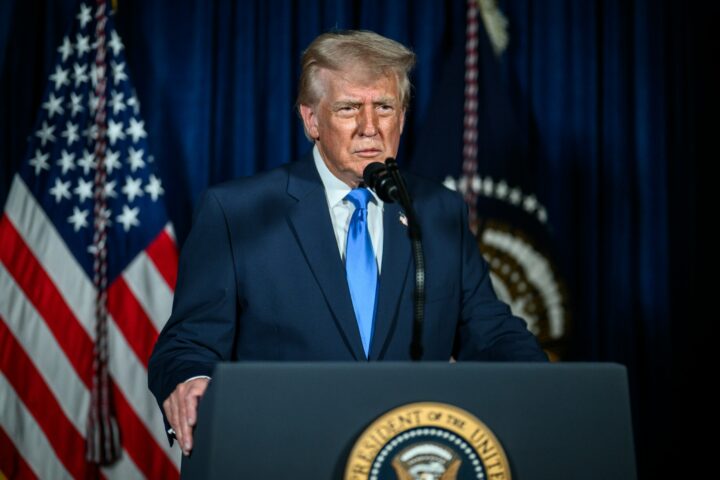
The denial follows a series of alleged assassination schemes stretching back before the current conflict. In July 2024, U.S. intelligence uncovered an Iranian plot against Trump that prompted increased Secret Service protection. Officials said there was no indication that the gunman who subsequently shot Trump at his Butler, Pennsylvania, rally was connected to that plot.
Federal prosecutors had previously accused a Revolutionary Guard member of offering $300,000 to have former national security adviser John Bolton killed, with former Secretary of State Mike Pompeo reportedly another target. Authorities linked the alleged scheme to retaliation for the 2020 U.S. strike that killed Iranian commander Qasem Soleimani. In late 2024, the Justice Department announced charges involving a separate alleged plot to kill Trump before the election.
Threats have also extended to Trump’s family. An Iraqi national with alleged ties to Iranian-backed militant networks was accused of plotting to assassinate Ivanka Trump in retaliation for Soleimani’s death, with sources saying the suspected operative obtained a blueprint of her Florida home. Last month, the Secret Service said it was reviewing an Iranian state television video that appeared to threaten Barron Trump.
Israel has also shared intelligence alleging a new Iranian plan to assassinate the president. Posters reading “Kill Trump” appeared at funeral events in July for the late Supreme Leader Ali Khamenei. Trump acknowledged the danger that month, saying: “I’m on whatever list … so far, I guess I’ve been a bit lucky, but maybe that doesn’t last very long. These are evil, sick people.”
White House spokesperson Anna Kelly rejected Pezeshkian’s denial. “The Iranian regime has murdered thousands of its own people, killed Americans overseas, executed acts of terrorism in the Strait of Hormuz, and launched indiscriminate attacks against its neighbors in the region,” she said. “The president is courageously ensuring that such an evil country never possesses a nuclear weapon, which will make the entire world safer and more stable.”
Pezeshkian also addressed the prolonged absence of Supreme Leader Mojtaba Khamenei, who reportedly suffered serious injuries in the U.S.-Israeli strike that killed his father in February. The president said they met about a month ago for roughly seven hours, sitting on pillows on the floor and walking around.
“I did not see any major challenges with his health or physical appearance,” Pezeshkian said. U.S. intelligence assessments in May indicated that Khamenei remained involved in directing Iran’s war strategy despite his injuries.
On negotiations, Pezeshkian said Iran wants an agreement but is not following a timetable tied to the U.S. midterm elections. Araghchi said Tehran submitted a proposal through mediators this week that would, according to Iran, reopen the Strait of Hormuz and restart talks toward a “final deal.”
The offer gives Washington seven days to meet conditions Araghchi declined to disclose. He said they went no further than the June Islamabad Memorandum of Understanding, which addressed sanctions relief, frozen assets and a halt to military operations, including in Lebanon. A White House official described the contacts as “positive and constructive discussions through the mediators.”
Pezeshkian nevertheless insisted that military pressure would not force Tehran to capitulate. “Of course, the U.S. has the power to destroy anything anywhere, but it is impossible to bring about Iranian surrender,” he said, following his declaration at the UN on Wednesday that Iran “will not bow down.”
He maintained that American bases used to attack Iran remain legitimate targets and claimed most U.S. bases in the region “are no longer useable.” A recent Pentagon watchdog report documented damage to hundreds of buildings and structures, though that finding alone does not establish that most bases are unusable.
The briefing placed senior Iranian officials under American protection while their government remained at war with the United States. A State Department official said the delegates were admitted solely for UN business and generally must remain near UN headquarters, JFK Airport or Iran’s UN mission unless granted permission to travel farther.