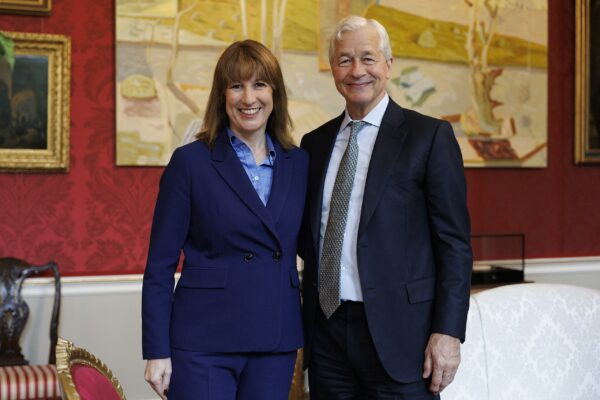
Jamie Dimon is sounding a cautious note about the direction of the economy, warning that the long-term fallout from President Donald Trump’s war in Iran could present serious challenges in the months and years ahead.
In his annual letter to shareholders released Monday, the JPMorgan Chase chief began by acknowledging that the U.S. economy remains “resilient.” Still, he made clear that resilience does not mean immunity, especially as geopolitical tensions continue to mount across multiple regions.
Dimon pointed to a wide range of global risks, placing the conflict in Iran alongside other major concerns. He cited the ongoing war and violence in Ukraine, broader instability in the Middle East, terrorist activity, and rising geopolitical tensions—particularly involving China—as key pressures that could weigh heavily on economic performance.
“The challenges we all face are significant,” Dimon wrote, emphasizing that the sheer number of risks increases the likelihood that one or more could have lasting consequences.
While the list of concerns is long, Dimon singled out the war in Iran as a potential driver of economic disruption. He warned that the conflict could lead to sustained shocks in oil and commodity markets, with ripple effects felt across global supply chains. Such disruptions, he suggested, could prove difficult to unwind.
As a result, Dimon cautioned that inflation may become more persistent than many expect. Instead of gradually easing, price pressures could harden, forcing central banks to keep interest rates higher for longer. That scenario, he argued, would challenge assumptions currently held by markets.
He described what he called “the skunk at the party” as the possibility that inflation begins to rise slowly rather than fall. If that were to occur—potentially as soon as 2026—it could trigger a chain reaction: higher interest rates, declining asset prices, and increased strain on both consumers and businesses.
Dimon also raised the specter of a recession, warning that the risk of a significant downturn in the near term cannot be ignored. While he did not predict a specific outcome, he stressed that economic contractions often result from a convergence of negative factors rather than a single event.
“A bad confluence of events,” he noted, can lead to varying degrees of recession, typically marked by rising unemployment, volatile markets, lower asset values, and increased credit losses. At the same time, he pointed out that no two recessions are identical.
In some scenarios, a downturn could help bring inflation under control. In others, however, inflation could persist or even worsen alongside economic contraction—a condition known as stagflation, where inflationary pressures outweigh the forces that typically reduce prices during a slowdown.
Despite the stark warnings, Dimon underscored that the ultimate goal should be a resolution to ongoing conflicts. He expressed hope for peace, even as he urged investors and policymakers to remain focused on the economic consequences tied to current global tensions.
His message reflects a broader reality: while military conflicts may be pursued for strategic reasons, their economic effects can extend far beyond the battlefield. Even a strong economy can face serious headwinds when global instability begins to reshape markets, supply chains, and expectations for the future.