Jennifer Griffin described a dramatic U.S. military operation Monday as an “eye-watering mission,” shedding light on the extraordinary lengths American forces went to rescue a downed airman stranded deep inside Iran.
The incident began when Iran shot down a U.S. F-15 fighter jet over its territory last week. One crew member was recovered quickly, but the second was forced to eject into mountainous terrain, where he remained hidden for more than a day at an altitude of roughly 7,000 feet. Alone and behind enemy lines, the airman relied on Survival, Evasion, Resistance, and Escape training—known as SERE—to avoid capture in an environment where the odds were stacked heavily against him.
According to Griffin, the breakthrough came when U.S. forces picked up an encrypted radio and beacon signal, allowing them to pinpoint his location. Troops were already on standby, prepared to move the moment they had a fix. When contact was established, the airman’s first reported message—“God is good”—offered a brief but powerful glimpse into the gravity of the situation.
What followed was a massive and coordinated rescue effort. Griffin reported that four B-1 bombers dropped nearly 100 satellite-guided 1,000-pound bombs, while MQ-9 Reaper drones engaged suspected Iranian fighters who came within several kilometers of the airman’s hiding place. The scale of the operation underscored both the urgency of the mission and the overwhelming force required to carry it out.
Footage from the scene, Griffin noted, showed injured and dead members of Iran’s IRGC and Basij forces who had been searching for the American. Despite the intensity of the operation, there were no reported American casualties during the rescue itself.
Complicating matters further, the Iranian regime had placed a bounty on the downed airman, offering what Griffin described as a “valuable reward” for his capture. That move expanded the danger beyond formal military forces, turning the search into a wider and more unpredictable threat.
Griffin emphasized the sheer scale and complexity of the mission. More than 100 Special Operations personnel were involved, along with dozens of aircraft and helicopters, all operating roughly 200 miles behind enemy lines. The target of the rescue—a weapon systems officer, or “Wizzo”—was located in one of the most challenging environments imaginable.
In addition to firepower and manpower, the operation also relied on deception. A reported CIA effort spread false information within Iran, suggesting that U.S. forces had already located the airman and were moving him on the ground for evacuation by sea. The tactic appears to have created confusion, buying critical time for the actual rescue effort to unfold.
“While the Iranians were confused and uncertain of what was happening, the agency used its unique capabilities to search for and find the American airman,” Griffin said, adding that those involved described the effort as “finding a needle in a haystack.”
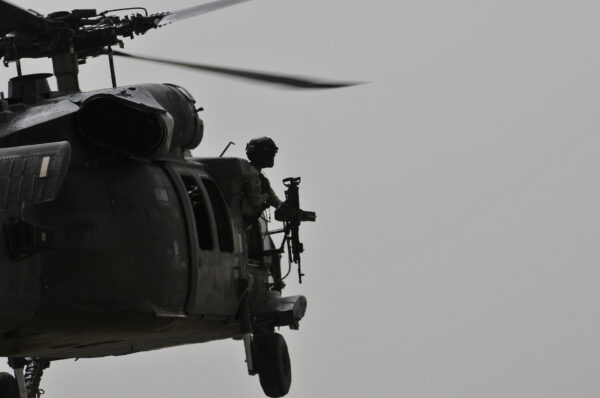
Ultimately, the airman—identified as an Air Force colonel—was found hiding inside a mountain crevice and extracted by an MH-60 Little Bird helicopter.
Griffin suggested that when all the details emerge, the level of heroism displayed could warrant multiple Medals of Honor.
At the same time, the mission stands as a reminder of the immense risks tied to such operations. The courage and precision required are undeniable, but so too is the reality that these high-stakes rescues take place only because of the dangerous conditions created by war.