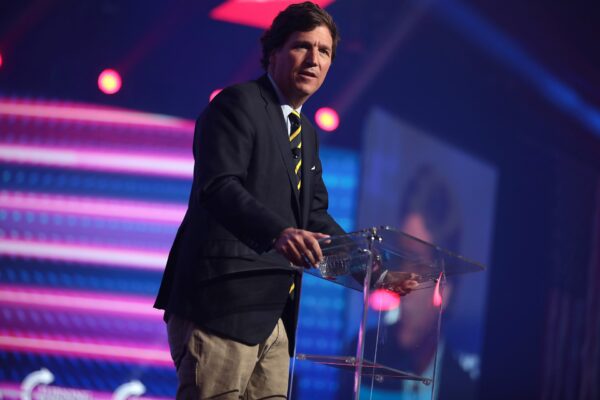
The ongoing clash between Tucker Carlson and President Donald Trump reportedly took a sharper turn Friday, with Carlson delivering one of his most striking remarks yet as tensions grow within conservative circles over the war in Iran.
According to a report from Newsmax Chief Washington Correspondent James Rosen, Carlson said he sympathizes with the president “as I do for all slaves,” a comment that quickly drew attention for both its tone and implications. Pressed on the statement, Carlson elaborated that he believes Trump is constrained, saying the president is “hemmed in by other forces” and unable to act independently.
The remarks reflect Carlson’s broader argument in recent days—that Trump may be operating under intense external pressure as the conflict in Iran continues to dominate the political landscape. Carlson has gone further, promoting a theory that the president is being influenced behind the scenes, even suggesting without evidence that Israel could be exerting leverage over U.S. policy decisions tied to the war.
In a written “morning note” released earlier Friday, Carlson framed his claims in a speculative tone, stating that what he described as a history of foreign influence tactics is not often discussed by mainstream media. He acknowledged, however, that he does not know whether such pressure is currently being applied to Trump, leaving his assertions unproven.
Still, Carlson struck a somewhat sympathetic posture toward the president, urging restraint from critics and calling for what he described as “grace.” He argued that Trump may be facing pressures significant enough to alter his decision-making, suggesting that such forces could push a leader away from campaign promises and toward actions they once opposed.
The president, for his part, has shown little patience for such commentary. In a blistering Truth Social post Thursday night, Trump lashed out at Carlson and other conservative media figures, including Megyn Kelly, Candace Owens, and Alex Jones. He accused them of undermining his position on Iran and used harsh personal language to dismiss their credibility.
Trump argued that his critics were effectively aligning with a hostile foreign power by opposing his stance, underscoring just how sharply the divide has grown among voices that once largely moved in lockstep. The exchange marks a notable escalation, as disagreements over foreign policy—particularly involving military conflict—spill into public view.
The dispute highlights a broader tension on the right. While some continue to support a forceful posture toward Iran, others have raised concerns about the direction and consequences of prolonged engagement. Carlson has positioned himself firmly in the latter camp, questioning not just strategy but the underlying pressures that may be shaping it.
At the center of the debate is a question that has long divided policymakers and commentators alike: how to balance national security interests with the risks and realities of extended conflict. As the rhetoric intensifies, the back-and-forth between Trump and Carlson suggests that even among allies, agreement is far from guaranteed.
In the end, the clash serves as a reminder that internal divisions can surface most sharply in moments of crisis, when the stakes are high and the path forward remains uncertain.
[READ MORE: Inflation Surges as Iran Conflict Drives Energy Spike, Raising New Concerns for U.S. Economy]