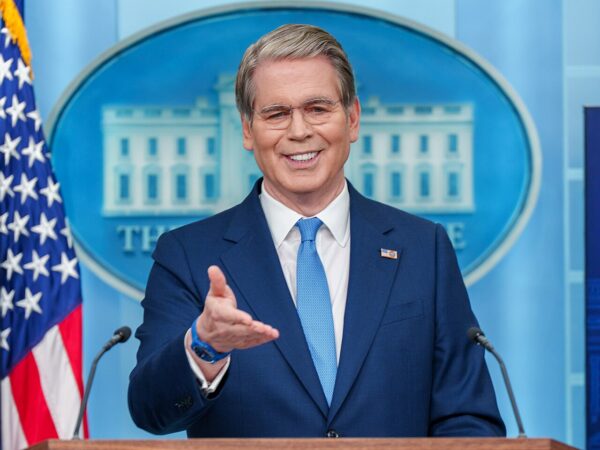
Treasury Secretary Scott Bessent issued a sweeping warning Monday to countries doing business with Iran, telling governments around the world to sever financial ties with Tehran or risk being cut off from the U.S. dollar system as the Trump administration launches a new economic pressure campaign.
The initiative, dubbed “Operation Economic Outcast,” is being promoted as a financial “D-Day” comparable to the Allied invasion of Normandy during World War II. But Bessent’s announcement included few immediate public actions, instead serving largely as a warning to countries maintaining economic relationships with Iran.
“Well, we are giving everyone the opportunity to remedy bad behavior, why would I want to blow up the global financial system?” Bessent said when pressed about the lack of specific actions.
Bessent said President Donald Trump is personally contacting world leaders, while officials from the Defense, Treasury and State departments are reaching out to foreign counterparts and demanding that they cut ties with Tehran.
The Treasury secretary declined to publicly identify governments being targeted or provide deadlines, saying those details were being communicated privately.
“We’re not going to name names,” Bessent said. “We’ve already seen some results, and I am confident the president, as you all know, is quite persuasive.”
He warned that countries refusing to cooperate could quickly face consequences.
“If they do not respond, then you will see the ramifications of their actions,” Bessent said.
Questions remain about China, Iran’s largest trading partner and main destination for Iranian oil exports, though those exports have declined sharply during the war.
Asked whether Beijing might receive special treatment, Bessent insisted that no country “is above the reach of U.S. sanctions.”
Treasury also announced expanded authority to sanction individuals anywhere in the world for operating in targeted sectors of Iran’s economy, including digital assets, technology, gold, aviation and shipping.
The department additionally imposed new sanctions against 60 entities, individuals and vessels connected to Iran’s nuclear and missile programs, cyber operations and oil revenue.
“Treasury has mapped every node, every facilitator, and every network that Iran has used to smuggle oil and evade sanctions,” Bessent said.
He framed Tehran’s options as either “complete global isolation and a subsistence economy” or returning to normal relations with the global economy.
The economic campaign comes six months into the war with Iran. Trump has said the conflict, which began at the end of February, was intended to prevent Iran from ever obtaining a nuclear weapon.
The United States has since imposed a naval blockade in the Strait of Hormuz, sharply reducing Iranian oil exports by sea.
Iran’s rial fell to a record low Monday of approximately 2.02 million to the U.S. dollar. Trump declared on Truth Social that Iran was in an “Economic and Military Death Spiral,” later writing, “IRAN IS COMPLETELY COLLAPSING!!!”
Despite the economic pressure, Iran continues to threaten shipping through the Strait of Hormuz, contributing to higher global energy prices. U.S. gas prices again climbed above $4 per gallon during the last month, according to AAA.
Iranian Parliament Speaker Mohammad Bagher Ghalibaf dismissed the administration’s pressure campaign, arguing that Iran’s trading partners were not taking Washington’s threats seriously.
Meanwhile, the United Arab Emirates announced last week that it was cutting trade ties with Tehran after facing renewed Iranian military attacks.
[READ MORE: Fox News’ Lawrence Jones Warns GOP Is Lacking ‘Energy’ Ahead of Midterms]