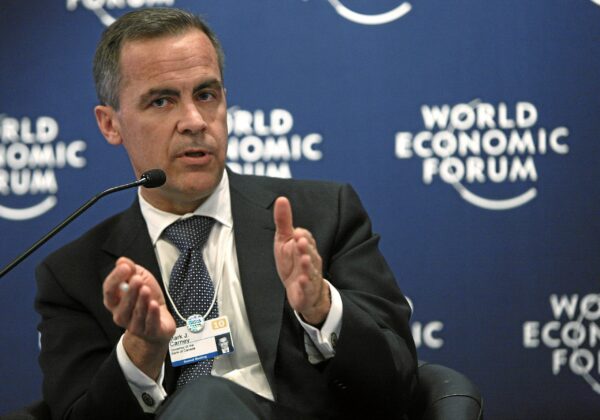
Canadian Prime Minister Mark Carney said Saturday that Canada and the United States are “making progress.” The fate of Canada’s auto industry remains a sticking point. Carney told reporters in Manila that he would not “settle for a deal” that failed to preserve “a viable Canadian auto sector.”
Carney said he spoke with President Donald Trump, U.S. Trade Representative Jamieson Greer, White House official Stephen Miller and others “just before” leaving for the Philippines for the three-day summit of the Association of Southeast Asian Nations. Trump is also scheduled to attend. Carney described his conversation with the president as “long” and “substantive.”
“There is a possibility of a deal, a bilateral deal, but we’re not yet there,” he said.
Canada suspended trade talks in August after Carney said the Trump administration made last-minute demands Ottawa could not accept. The United States then imposed tariffs of 50 percent on roughly $20 billion in Canadian goods. Ottawa imposed matching tariffs after Canadian officials pledged to respond “dollar for dollar.” The trade war caused the GOP major problems in much of the Midwest.
Carney said American automakers also have a stake in the outcome because the U.S. auto industry depends in part on Canadian manufacturing, according to The Hill. “This is one of the fundamental issues in our trade negotiation, and we are making progress,” he said. “This is one of the most challenging issues in the trade negotiations,” Carney said. “As I say, we’re making progress. We’re not there yet.”
In Manila, Carney also announced two trade agreements, one with ASEAN and the other with the Philippines. “Today’s announcements are part of a strategy of developing a dense web of reliable partners to create more opportunities for our businesses, more choice for Canadians, better jobs for our workers, and reducing our relative reliance on the United States,” he said.
Carney said Canada is ahead of schedule in its effort to double exports to markets outside the United States within a decade. Those markets now account for nearly one in three Canadian export dollars, the highest share in 40 years, he said.