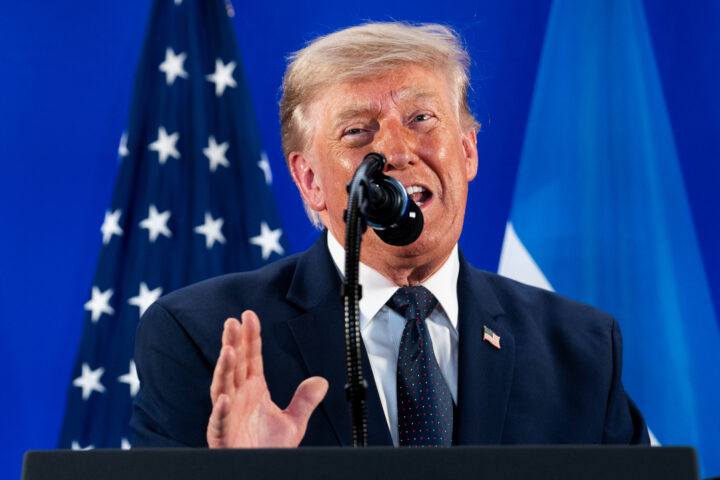
President Trump announced Wednesday that he will require data centers to produce their own electricity and hand over “any excess” energy to neighboring communities, a move aimed at preventing electricity costs from climbing.
The president made the announcement on Truth Social, saying he has been keeping a close eye on the industry.
“As the President of the United States, I have been watching Data Centers very closely, and have come to a very strong conclusion,” Trump wrote. “New and large, in some cases gigantic, Data Centers are mandated by me to make their own electricity, and give or sell any excess back to the local community, or grid.”
Trump suggested the policy could do more than simply hold the line on prices.
“In fact, there could be a substantial decrease. Other elements likewise!” he wrote.
The president acknowledged that data centers have been “highly unpopular in a certain area,” but argued they become “extremely popular when a financial deal is struck.”
“MAKE DEALS, and get them built!!!” Trump concluded.
Tech companies, in step with Trump’s embrace of building out AI infrastructure, have argued that new data centers are essential to supporting the emerging technology’s development. Dozens of companies, including Meta, Amazon and Google, have already agreed to cover increased energy costs caused by their data centers under Trump’s ratepayer protection pledge.
Still, the facilities place heavy demands on local resources. A medium-sized data center can use up to roughly 110 million gallons of water a year for cooling, about the same as the annual water usage of 1,000 households, according to an analysis released last year by the nonprofit Environmental and Energy Study Institute.
Trump has not shied away from taking on the projects’ critics. Last month, the president claimed opponents of data centers want “poverty, crime and squalor,” and accused communities resisting the facilities of wanting to be “backwards and poor.”
Earlier this month, with a tight Senate race underway in Ohio, Trump highlighted how “much money” the state stands to make from data centers, even as some Ohioans have criticized the development.
“You can’t just turn them off. They’ll go to China,” Trump said at a rally for Sen. Jon Husted, R-Ohio. Opponents in the Buckeye State have criticized Husted for pushing to bring data centers to Ohio during his time as lieutenant governor.
Many Americans have grown wary of the projects, citing concerns that they could drive up electricity bills, strain water supplies and generate noise or air pollution. Some communities have enjoyed a boost in tax revenue from data centers, while others have offered tax breaks to lure the investments.
In recent months, states including Ohio and Illinois have paused such tax incentive programs, and others have gone even further. New York put in place the nation’s first statewide freeze on new “hyperscale” data centers.
The backlash against AI has also been fueled by fears over the dangers of rogue software, especially following recent attempted and successful hacks into government websites. Those concerns also follow a warning from Jacob Coxon, a former researcher at OpenAI and Anthropic, that AI could pose an existential threat to humanity by the end of the decade.
[READ MORE: Kyle Kennedy, Granddaughter of Bobby and Ethel Kennedy, Dies at 42]