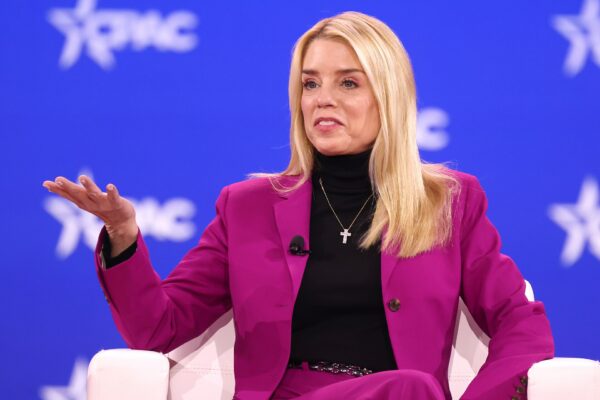
President Donald Trump has reportedly tapped former Attorney General Pam Bondi to join a high-profile White House panel focused on science and technology policy, marking a notable return for one of Trump’s longtime allies less than two months after her departure from the Department of Justice.
Bondi will serve on the President’s Council of Advisors on Science and Technology, commonly known as PCAST, according to a White House official. The appointment comes as Bondi recovers from treatment for thyroid cancer, a development first reported by Axios.
Vice President JD Vance praised Bondi’s continued role in the administration, describing her as a trusted figure within Trump’s inner circle.
“Pam has been an enormously valuable asset to the president’s team, and I’m thrilled for her and for all of us that she’s going to remain involved in confronting some of the most important issues the administration faces,” Vance said in a statement released by the White House.
Bondi joins a council packed with major names from the technology and business worlds as the administration wrestles with growing questions surrounding artificial intelligence, cybersecurity, and America’s escalating competition with China in advanced technology development.
David Sacks, who co-chairs the advisory panel, defended Bondi’s selection on X, arguing her legal background makes her especially valuable as the administration navigates increasingly complex regulatory questions surrounding AI.
“No one is better positioned to support PCAST and to advise the president on legal and regulatory matters,” Sacks wrote, adding that he was “excited to have her on board.”
Sacks, who previously served as Trump’s White House AI and cryptocurrency czar, has emerged as one of the administration’s leading advocates for a light-touch regulatory approach to artificial intelligence. He has repeatedly warned that excessive government intervention could slow American innovation while allowing China to gain ground in the rapidly developing AI sector.
“President Trump understands that unnecessary regulation is the biggest threat to innovation in America,” Sacks wrote. “Winning the AI race means not only beating China but also clearing bureaucratic hurdles thrown up by state legislatures and woke politicians in DC.”
The advisory council is jointly chaired by Sacks and Michael Kratsios. Other members include major Silicon Valley figures such as Jensen Huang, Mark Zuckerberg, Larry Ellison, and venture capitalist Marc Andreessen.
Bondi’s appointment comes during a period of apparent turbulence inside the White House over AI policy. In recent weeks, Trump abruptly canceled a planned executive order involving voluntary AI safety testing after reportedly expressing concerns that the proposal could hinder America’s technological edge against China.
According to a draft obtained by The Hill, the executive order would have created a system allowing AI companies to voluntarily submit advanced models for government testing for up to 90 days before public release.
Trump reportedly told reporters he “didn’t like certain aspects” of the order, particularly concerns that the policy might slow the United States in what administration officials frequently describe as the race with China to dominate artificial intelligence.
The order was pulled just hours before a planned signing ceremony, highlighting what appears to be growing disagreement within the administration over how aggressively the federal government should oversee emerging technologies with potentially massive economic, political, and national security consequences.
As the White House continues balancing innovation, regulation, and geopolitical competition, the increasingly urgent language surrounding the so-called AI race reflects a broader atmosphere in Washington where technological development is now being framed less as a scientific pursuit and more as another front in an intensifying global power struggle.