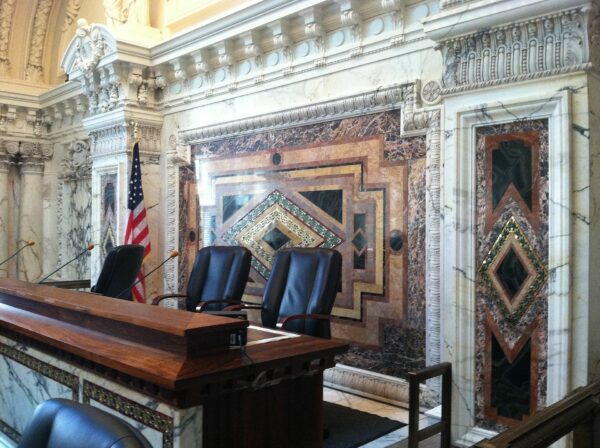
A federal court on Tuesday struck down Alabama’s congressional map, ruling that the state’s Republican-led legislature intentionally discriminated on the basis of race when it redrew district lines following years of legal battles over representation and voting rights.
The ruling comes as both Republicans and Democrats across the country have increasingly turned to aggressive redistricting efforts ahead of the looming midterm elections, intensifying concerns that political warfare over maps is further eroding public confidence in elections and representative government.
In a major setback for Republicans in Alabama, a three-judge federal panel — including two judges appointed by President Donald Trump — concluded that the state’s 2023 congressional map violated the Fourteenth Amendment by intentionally diluting Black voting power.
The panel included Circuit Judge Stanley Marcus along with District Judges Anna M. Manasco and Terry F. Moorer. Both Manasco and Moorer were appointed to the bench by Trump.
The dispute centered on a map approved by Alabama lawmakers in 2023 that reduced the number of majority-minority congressional districts from two to one. The case has already bounced repeatedly between lower courts and the Supreme Court as legal fights over racial gerrymandering continue reshaping election law nationwide.
The judges said they revisited the case following the Supreme Court’s earlier ruling in Louisiana v. Callais, where the nation’s highest court held that racial gerrymandering — whether used to create or reduce majority-minority districts — violates federal law and the Constitution.
After what the panel described as a “careful” review of the evidence, the judges said the conclusion remained unchanged.
“The undisputed evidence left us in no doubt that Alabama’s legislatively enacted plan intentionally discriminated based on race in violation of the Constitution,” the ruling declared.
The court accused Alabama lawmakers of knowingly refusing to adopt a lawful remedy after earlier findings of discriminatory vote dilution. According to the ruling, legislators were fully aware that the map would weaken Black voters’ electoral influence and moved forward anyway.
Judges also rejected Alabama’s defense that partisan politics — not race — drove the map-drawing process. The opinion stated the court found “no evidence of a partisan motive” after reviewing extensive testimony and legislative records.
With the 2026 elections rapidly approaching, the panel issued a preliminary injunction blocking use of the 2023 map and instead ordered Alabama to use a previously created “race-blind” map developed by a special master. The judges argued the substitute map would avoid disruption because candidates and election systems had already been operating under it until recently.
The ruling arrives amid broader national fights over redistricting, as states controlled by both parties redraw congressional lines in hopes of gaining political advantage before the midterms. Some Republican lawmakers have reportedly expressed concern that new GOP-favored districts may rely too heavily on optimistic assumptions tied to Trump’s 2024 performance.
Meanwhile, the NAACP praised the decision, calling it a victory for Black representation and linking the dispute to Alabama’s long and painful civil rights history.
Although the ruling marks a major moment in the case, the legal battle is far from over. The judges ordered an expedited litigation schedule and indicated the dispute is expected to continue beyond the November elections and into 2027
[READ MORE: Trump Approves Emergency Aid as California Battles Toxic Chemical Threat in Orange County]