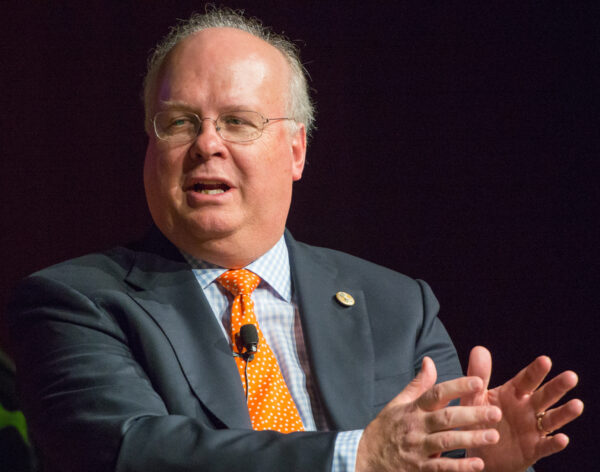
Veteran Republican strategist Karl Rove is now reportedly sounding the alarm over the GOP’s prospects in November’s midterm elections, warning that even aggressive redistricting efforts may not be enough to protect Republicans if President Donald Trump continues on his current political trajectory.
Writing in a sharply critical column for The Wall Street Journal titled “Gerrymandering Isn’t Enough for the GOP,” Rove argued that Republicans are facing mounting political headwinds despite favorable district maps in several states.
According to Rove, the numbers already point to a troubling environment for Republicans heading into the midterms. He noted that Democrats currently hold a sizable advantage on the generic congressional ballot, citing Nate Silver’s Silver Bulletin polling average showing Democrats ahead by 6.6 points, while a recent New York Times/Siena survey placed the Democratic advantage at 11 points.
Rove argued that Trump’s declining approval ratings are a major factor behind the widening gap.
“The GOP’s chances will get worse if President Trump’s approval numbers keep declining,” Rove wrote. “They’re already dangerously low.”
He pointed to the RealClearPolitics polling average, which placed Trump’s approval rating at 39.8% on Wednesday — the lowest level of his second term so far.
The longtime GOP operative also criticized what he described as a lack of message discipline from the administration, particularly regarding the conflict involving Iran. While many Republican voters remain supportive of a strong national defense, divisions have emerged within conservative circles over the possibility of deeper foreign involvement abroad and the economic strain that often accompanies prolonged international conflicts.
Rove suggested the White House has struggled to communicate a steady and reassuring message during a tense geopolitical moment.
“Making things worse are Mr. Trump’s erratic late-night missives,” he wrote. “The president comes across more as a heckler at a UFC match than as a reassuring wartime commander in chief.”
Beyond foreign policy, Rove argued Trump is undercutting his own domestic messaging by overshadowing policy wins with controversies and rhetoric that may alienate swing voters already frustrated over economic conditions.
He pointed to Trump’s announcement that 600 generic drugs would be added to the government’s online low-cost drugstore program as a political positive for the administration. But Rove argued the moment was quickly drowned out by other headlines, including Trump’s appearance at a White House ballroom construction site where the president promoted a $1 billion request for “security measures.”
Rove warned that such messaging may not resonate with voters grappling with high fuel costs and broader economic anxieties.
“The president’s promoting his $1 billion request for White House ‘security measures’ won’t convert voters,” Rove wrote, adding that Americans upset about $5-per-gallon gasoline were unlikely to be reassured after Trump reportedly dismissed those prices as “peanuts.”
The former White House adviser also urged Republican candidates to put some distance between themselves and Trump on the campaign trail, even while benefiting from his fundraising abilities.
Rove encouraged GOP candidates to publicly disagree with certain administration priorities, including the proposed ballroom project and a controversial $1.8 billion fund that critics fear could benefit Jan. 6 defendants.
“The more undisciplined the White House messages on war and the economy, the more at risk GOP candidates will be,” Rove concluded.
He added that the more Trump inserts himself into the campaign, the more likely Republicans could lose control of the House, warning that favorable maps alone may not be enough to overcome voter dissatisfaction over the economy and growing unease surrounding America’s direction at home and overseas.