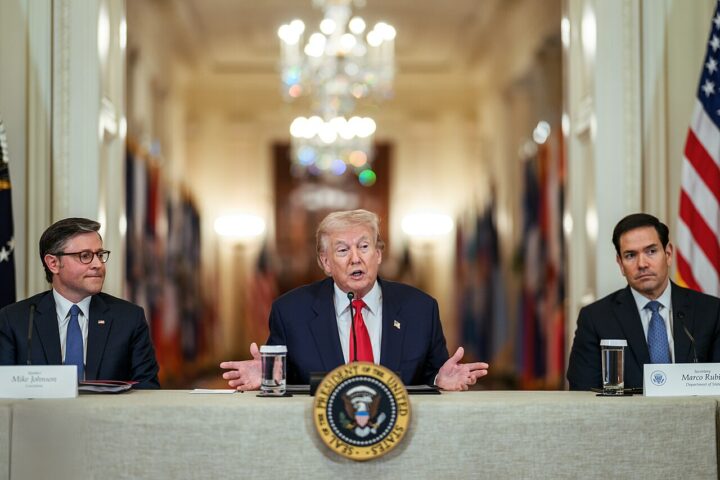
President Donald Trump reportedly issued a pointed warning from the Oval Office on Tuesday, signaling that the fragile ceasefire with Iran may be nearing a breaking point as new incidents raise questions about its durability.
Speaking during an event with young athletes, Trump was asked by Daily Caller White House correspondent Reagan Reese what actions by Iran would constitute a violation of the ceasefire. The president declined to offer specifics, instead delivering a message that suggested the stakes are well understood on both sides.
“They know what to do. They know what not to do,” Trump said, adding that any determination of a breach would be made clear in time.
The president went on to describe recent confrontations at sea, portraying Iran’s naval capabilities as diminished while emphasizing the strength of U.S. forces. He referenced small, fast boats used by Iranian forces, contrasting them with what he described as the overwhelming superiority of the American Navy. Trump also pointed to the effects of a U.S. blockade, claiming that attempted movements by Iranian vessels had been quickly neutralized.
His remarks come amid growing signs that the ceasefire agreement reached last month is under strain. Reports of new clashes in the strategically vital Strait of Hormuz have raised concerns about whether the uneasy pause in hostilities can hold.
According to reporting from CNN national security correspondent Natasha Bertrand, U.S. Central Command chief Bradley Cooper confirmed that American military and commercial ships were targeted by Iranian forces earlier in the day. The Strait of Hormuz remains a critical artery for global energy supplies, making any escalation in the region particularly consequential.
Trump, in separate remarks to Fox News reporter Trey Yingst, delivered an even sharper warning, stating that any attempt by Iran to strike U.S. vessels would be met with overwhelming force.
Despite the exchange of fire, Defense Secretary Pete Hegseth sought to downplay the implications for the ceasefire. Speaking earlier at the Pentagon, Hegseth characterized the incident as a “separate and distinct project,” suggesting it did not amount to a formal collapse of the agreement.
The differing tones—forceful warnings from the president and a more measured assessment from the Pentagon—highlight the uncertain state of the situation. While officials stop short of declaring the ceasefire broken, the reality on the ground appears increasingly volatile.
At the center of the tension is the question of how long such a delicate arrangement can withstand repeated provocations. Ceasefires, by their nature, rely on restraint and clear lines—both of which can quickly erode when confrontations continue, even in limited form.
For now, the administration is maintaining that the agreement remains intact, even as it prepares for the possibility that it may not hold. Trump’s comments suggest a readiness to respond decisively if conditions worsen, while also underscoring the challenge of enforcing calm in a region where even small incidents can carry outsized consequences.
As events unfold in the Strait of Hormuz, the situation serves as a reminder that pauses in conflict can be as precarious as the conflicts themselves, with stability often hinging on moments that pass in seconds but carry implications that last far longer.
[READ MORE: Alberta Separatists Push Referendum Bid as Political Reality Check Looms]