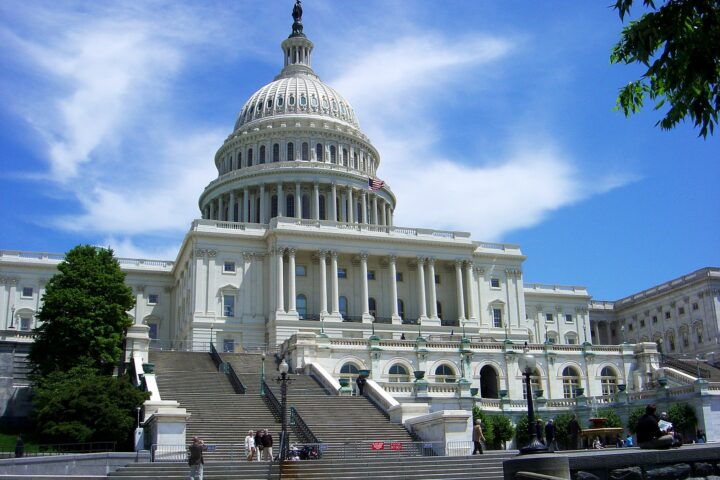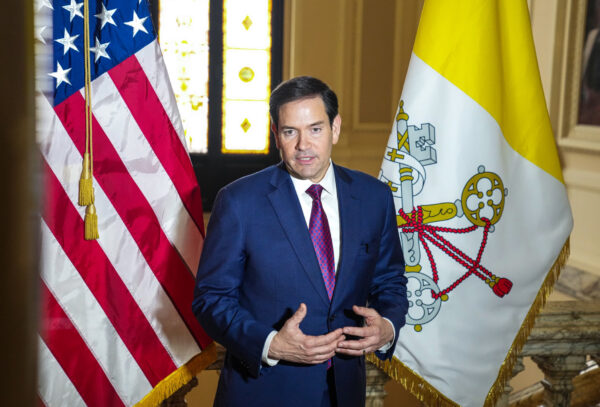
Secretary of State Marco Rubio is set to host a high-stakes diplomatic meeting in Washington on Tuesday, bringing together Israeli and Lebanese officials for the first formal talks between the two nations in decades, as renewed violence threatens to deepen an already volatile situation.
According to a State Department official speaking to NewsNation, Rubio will participate in the discussions alongside Yechiel Leiter and Nada Hamadeh. Also expected to attend are Michel Issa and Counselor Michael Needham, underscoring the seriousness of the effort as Washington attempts to navigate a complex and dangerous moment in the region.
The talks, authorized by Israeli Prime Minister Benjamin Netanyahu, are expected to center on securing a ceasefire and addressing the presence of Iran-backed Hezbollah militants. If successful, the discussions could mark a significant step toward de-escalation. If not, they risk becoming another missed opportunity in a region where diplomacy often struggles to keep pace with violence.
An official speaking anonymously told The Associated Press that this would be the first time Israel and Lebanon have held such talks since 1993—a reminder of how rare and fragile these moments of direct engagement truly are.
The urgency behind the meeting is hard to ignore. Fighting in Lebanon has intensified in recent weeks, threatening to unravel a fragile two-week ceasefire negotiated between the United States and Iran. Confusion over whether Lebanon was included in that truce has only added to the uncertainty, with the U.S. and Israel saying it was not part of the agreement, while Iran and Pakistan have suggested otherwise.
That uncertainty gave way to a dramatic escalation last Wednesday, when Israeli forces carried out what they described as their largest coordinated strike inside Lebanon, targeting roughly 100 sites linked to Hezbollah. The scale of the attack—and its aftermath—illustrates the human cost that continues to mount as diplomacy lags behind events on the ground.
Figures cited by the United Nations from Lebanon’s Health Ministry indicate that at least 300 people were killed and more than 1,150 injured in the strikes, marking one of the deadliest single days since the conflict reignited in early March. The broader toll is even more sobering. According to reporting from the Associated Press, at least 2,089 people have been killed in Israeli strikes, including women, children, and medical workers, while more than 1 million have been displaced.
Israeli officials have defended their actions, emphasizing that their operations are directed at Hezbollah rather than the Lebanese people. A spokesperson for Netanyahu’s office stated that the militant group is being steadily weakened and described ongoing U.S.-mediated talks as an effort to eliminate the threat and move toward peace.
But not all parties are willing to engage. Hezbollah leader Naim Qassem has urged the Lebanese government to cancel the Washington meeting, calling it pointless, while also signaling that the group will continue its confrontation with Israeli forces. Israel, for its part, has ruled out a ceasefire under current conditions.
Against this backdrop, Rubio’s meeting represents a narrow opening for diplomacy at a time when the momentum appears to favor continued conflict. Whether that opening leads to meaningful progress—or closes amid ongoing violence—may determine not only the immediate future of the region, but how long civilians remain caught in the crossfire of a conflict that shows no easy end.