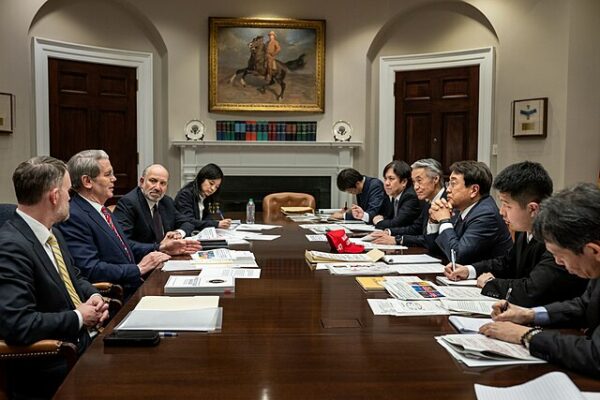
Commerce Secretary Howard Lutnick has become one of the most visible dealmakers in President Donald Trump’s second term—an aggressive broker of headline-grabbing trade agreements and investment pledges designed to reinforce the administration’s America First agenda. But behind the announcements, friction inside the administration and mounting controversies are testing both his management style and his political durability.
A former Wall Street executive who moved from leading Cantor Fitzgerald to running the Commerce Department, Lutnick has helped unveil a slate of high-profile agreements: sweeping trade pacts with the European Union and Japan, a $250 billion investment framework with Taiwan, and initiatives aimed at securing American stakes in strategic industries such as Intel and U.S. Steel. Allies credit him with injecting urgency into tariff negotiations and aligning Commerce with Trump’s confrontational trade posture.
Inside the administration, however, writes Politico, things are a little different. Critics portray Lutnick as brash and highly centralized, frequently inserting himself into projects across agencies. While some say his involvement accelerates decisions, others argue it slows coordination by requiring his personal sign-off before Commerce officials can articulate policy positions. Reports of elevated turnover among political appointees have circulated, though a White House spokesperson has denied that departures exceed typical levels.
The pattern has extended to major industrial initiatives. In late 2025, the administration rolled out a framework agreement with Westinghouse Electric Co., promoted as an $80 billion arrangement that could involve Japanese purchases of at least 10 large-scale nuclear reactors using the company’s AP1000 technology. Supporters framed the deal as a strategic push to expand U.S.-linked nuclear capacity amid rising global energy demand. Skeptics countered that the announcement was expansive in scope but thin on operational detail—raising concerns about timelines, cost controls, and execution, particularly given Westinghouse’s history of significant overruns on prior projects.
Political pressure intensified after documents released from the Jeffrey Epstein files revealed communications between Lutnick and Epstein, as well as a 2012 family lunch on Epstein’s private island—an encounter that critics say appears to contradict Lutnick’s earlier statements that he had cut ties years before. Lutnick addressed the matter during congressional testimony, characterizing the visit as brief and familial and denying any wrongdoing. Nevertheless, lawmakers from both parties, including several Republicans, have called on him to resign, arguing the controversy risks distracting from economic policy at a critical juncture.
Additional strain has come from reports that Lutnick’s family has benefited financially from Cantor Fitzgerald’s strong revenue growth in 2025, amid the firm’s heightened profile during his tenure. According to sources familiar with internal discussions, Trump raised the optics of those gains directly with Lutnick.
Despite the turbulence, public backing from the White House has been unequivocal. A spokesperson said the president retains “complete confidence” in Lutnick as “the most transformative Commerce Secretary in modern history,” crediting him with advancing major trade victories. A person close to Lutnick emphasized that he remains actively engaged with technology executives and global investors to ensure commitments are fulfilled, with tariffs positioned as leverage if necessary.
For now, Lutnick continues to appear alongside Cabinet officials and travel with the president, projecting stability. But the durability of his tenure may ultimately depend less on announcements than on delivery—whether the promised investments solidify into factories, supply chains, and jobs, and whether further controversies can be avoided.
[Read More: Trump Goes On Endorsement Blitz]