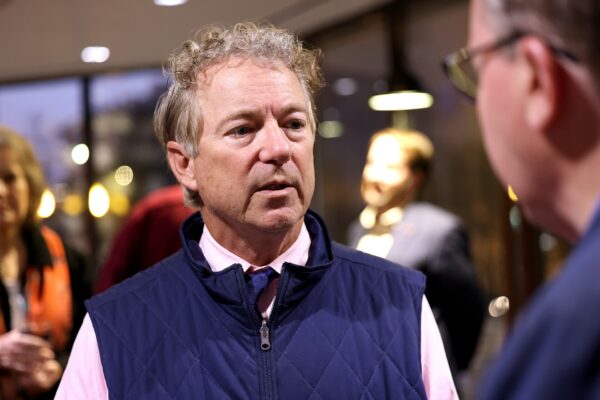
Sen. Rand Paul on Tuesday forcefully rejected President Donald Trump’s suggestion that Republicans should “nationalize” elections by asserting federal control over voting procedures in multiple states, warning that such a move would violate the Constitution and upend long-standing principles of federalism.
In an interview with Stephanie Ruhle on MSNBC’s MS NOW, Paul addressed Trump’s remarks directly. “That’s not what the Constitution says about elections,” the Kentucky Republican said, arguing that primary authority over election administration rests with the states, not Washington.
Paul acknowledged that the Supreme Court has imposed limited uniformity in certain election-related matters, such as preventing individual states from unilaterally setting term limits for federal officeholders. But he emphasized that the Constitution clearly assigns responsibility for administering elections to the states. “But as far as the time, place and manner of elections, that, under the Constitution is a state activity,” Paul said. “So, I’m not for nationalizing it.”
The senator also stressed that his opposition is consistent with positions he has taken under both parties. “I was against [former Speaker] Nancy Pelosi’s [D-Calif.] bill, which would have nationalized it, but I would also be against any bill coming from this administration that would nationalize elections,” Paul added.
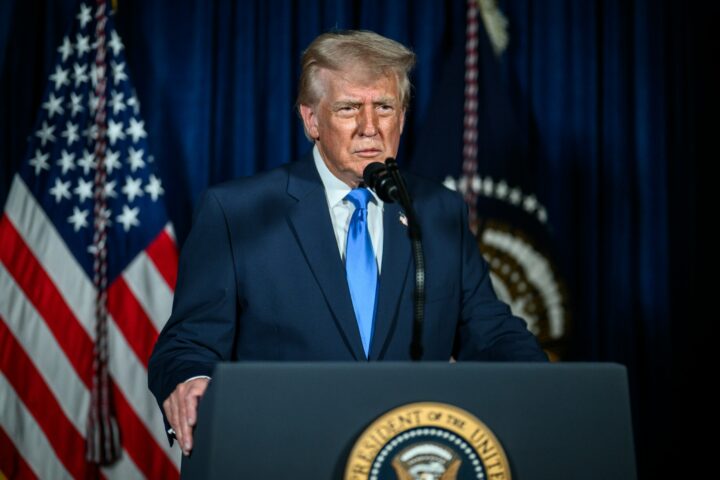
Trump’s comments originated during a podcast appearance Monday with conservative commentator and former FBI official Dan Bongino, where the president urged Republicans to assert control over voting in at least 15 unspecified locations. “The Republicans should say, ‘We want to take over,’” Trump said, adding, “The Republicans ought to nationalize the voting.”
The president reiterated that position Tuesday in the Oval Office, calling for expanded federal involvement to address what he described as “horrible corruption on elections.” “The federal government should not allow that,” Trump said. “The federal government should get involved.”
Requiring identification to vote, a rule that is standard across most democratic countries, is widely supported in the United States across both parties and all ethnicities.
The proposal has prompted resistance from other senior Republicans, including Senate Majority Leader John Thune. While Thune voiced support for voter identification requirements to confirm citizenship, he rejected the idea of federalizing election administration. “I’m supportive of only citizens voting and showing ID at polling places,” Thune told reporters. “I think that makes sense. … But I’m not in favor of federalizing elections, no. I think that’s a constitutional issue.”
Thune also defended the decentralized structure of U.S. elections on practical grounds. “I’m a big believer in decentralized and distributed power,” he said. “And I think it’s harder to hack 50 election systems than it is to hack one. In my view, at least, that’s always a system that has worked pretty well.”
Trump’s push comes as his administration continues to emphasize election integrity concerns ahead of the 2026 midterm elections, particularly allegations of corruption and noncitizen voting.