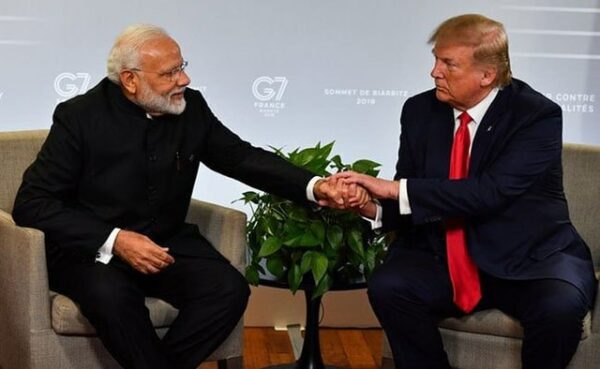
President Donald Trump announced Monday that the United States has reached a new trade deal with India, highlighting what he described as a significant breakthrough following commitments from Indian Prime Minister Narendra Modi on energy purchases and tariffs.
In a post on Truth Social, Trump said it was “an honor” to speak with Modi earlier in the day, noting that the two leaders discussed trade as well as efforts to end the war between Russia and Ukraine. Trump framed the conversation as productive and underscored what he portrayed as growing cooperation between Washington and New Delhi under his leadership.
Modi confirmed the agreement shortly afterward in a post on X, striking a warm tone and publicly thanking Trump for the outcome. Modi said that “Made in India” products will now face a reduced tariff rate of 18 percent, calling the move a major win for India’s economy.
“Wonderful to speak with my dear friend President Trump today,” Modi wrote. “Delighted that Made in India products will now have a reduced tariff of 18%. Big thanks to President Trump on behalf of the 1.4 billion people of India for this wonderful announcement.”
Trump has also emphasized the energy component of the agreement, saying India agreed to buy U.S. oil and potentially oil from Venezuela rather than continuing to purchase oil from Russia. Over the weekend, Trump told reporters aboard Air Force One that the deal was already in place in concept.
“We’ve already made that deal, the concept of the deal,” Trump said Saturday, signaling confidence that India would follow through on the shift.
The announcement follows a period of escalating pressure from the Trump administration on India over its energy purchases. Last year, Trump raised import tariffs on India to 50 percent after the country continued buying Russian oil. He has repeatedly argued that such purchases undermine U.S. interests and weaken efforts to isolate Moscow.
India’s oil decisions have also been shaped by Trump’s earlier moves involving Venezuela. India halted its purchases of Venezuelan oil last year after Trump imposed a 25 percent tariff on countries buying crude from that nation. More recently, Trump warned that tariffs on India could rise again if it did not stop buying Russian oil, making clear that economic consequences would follow if U.S. concerns were ignored.
Trump suggested that his firm negotiating approach played a key role in securing the agreement, portraying the outcome as evidence that tariffs remain an effective tool in trade talks.
“Modi is a good guy,” Trump said. “He knew I was not happy, and it was important to make me happy.” Trump added that India conducts extensive trade with the United States and acknowledged that Washington has the ability to raise tariffs quickly if necessary.
“They do trade, and we can raise tariffs on them very quickly,” Trump said, reinforcing his long-standing view that leverage at the negotiating table produces results.
The deal marks the latest example of Trump using tariffs and tough rhetoric to extract concessions from foreign governments, a strategy he has defended throughout his presidency. Supporters say the agreement with India shows that approach can deliver tangible outcomes, while also advancing U.S. economic and strategic interests.
As details of the agreement continue to emerge, Trump has positioned the deal as a win for American energy producers and a sign of renewed momentum in U.S.-India relations under his leadership.
[READ MORE: Trump Vows Lawsuit After Trevor Noah’s Epstein Joke Sparks Grammy Night Backlash]