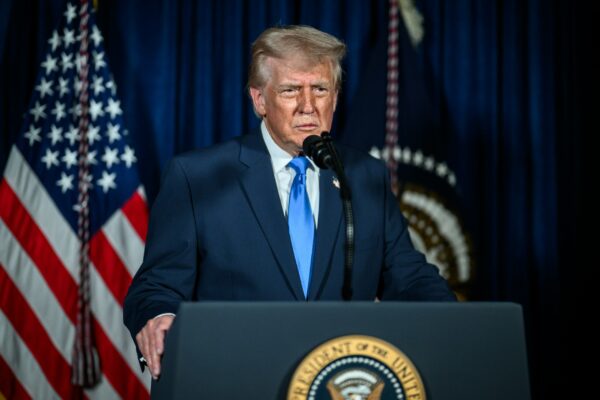
President Donald Trump on Friday renewed his push for the Senate to eliminate the filibuster, arguing that the long-standing procedural rule has been weaponized by Democrats to paralyze government and inflict real damage on the country.
Trump made the call in a post on his Truth Social account, where he shared screenshots of an op-ed written by Treasury Secretary Scott Bessent. “It’s time to end the filibuster,” Trump wrote, echoing the title and central argument of Bessent’s piece.
In the op-ed, published by the Washington Post, Bessent argued that Americans were just emerging from what he described as the longest and most devastating government shutdown in U.S. history. He placed responsibility squarely on Senate Democrats, saying they used the filibuster to hold the country hostage and force concessions.
Bessent warned that unless Republicans act, the same scenario could play out again in January, when Congress is once more set to face a deadline to keep the government funded. According to Bessent, the filibuster’s 60-vote threshold allowed Democrats to block legislation and cause widespread harm.
He cited specific consequences of the shutdown, including $11 billion in permanent economic damage, an estimated 1.5 percentage-point hit to GDP growth in the fourth quarter of fiscal 2025, 9,500 canceled flights, and the paychecks of 1.4 million federal workers being delayed. Bessent described those workers as having their livelihoods “held for ransom” by what he called the left’s demands.
The Treasury secretary also challenged the notion that the filibuster is a sacred or untouchable Senate tradition. He argued that the rule is not mentioned anywhere in the Constitution and described it as a historical accident that evolved into a de facto veto for the minority, enabling gridlock and inaction.
To support his point, Bessent pointed to past actions by both parties. He noted that Democrats eliminated the filibuster for most presidential nominations in 2013 under then-Majority Leader Harry Reid. Republicans later removed the filibuster for Supreme Court nominations in 2017. In both cases, Bessent wrote, the Senate endured and the country carried on.
Trump has also called for ending the use of blue slips, a separate Senate practice that allows home-state senators to block judicial nominees. So far, however, those proposals have failed to gain broad support among Republican lawmakers.
Sen. John Kennedy said publicly that he has already told Trump the filibuster is unlikely to be eliminated. In a November interview with CNN’s Manu Raju, Kennedy said he told the president directly that part of his role in the Senate is to stop what he views as bad ideas, including ending the filibuster.
Kennedy said Trump did not react angrily to the disagreement, even though the two see the issue differently. While acknowledging he could be wrong, Kennedy expressed skepticism that the filibuster or the blue slip tradition would be scrapped anytime soon.
Despite resistance on Capitol Hill, Trump’s renewed call highlights growing frustration among Republicans who argue that Senate rules are being exploited to block governance, even as Democrats previously altered those same rules when it suited their priorities.
[READ MORE: Late-Night TV’s Leftward Tilt Hits New Extreme as Conservatives Become Punchline]