Australian Prime Minister Anthony Albanese said Monday that his left-wing government stands “prepared” to impose even more restrictive gun laws following a deadly antisemitic terror attack at a Hanukkah celebration in Sydney that left at least 15 people dead and dozens more wounded.
Albanese responded to the Sunday night massacre by signaling a renewed crackdown on lawful gun ownership, arguing the country must “take whatever action is necessary” in the wake of the attack, according to the Associated Press. “Included in that is the need for tougher gun laws,” Albanese said.
Australia already enforces some of the strictest firearms regulations in the world. Following the 1996 Port Arthur massacre, where a gunman killed 35 people, the federal government enacted a mandatory buyback program and imposed sweeping bans on civilian ownership of semi-automatic rifles and pump-action shotguns. Legal gun ownership is tightly regulated, with mandatory background checks, a 28-day waiting period, and strict licensing requirements.
Under Australia’s Firearms Act of 1996, citizens must provide a “genuine reason” to own a firearm, such as hunting, farming, sport shooting, or historical collecting. Personal self-defense is explicitly not considered a valid reason under Australian law.
Still, Albanese and other national leaders argued that the existing framework must be tightened further. New South Wales Premier Chris Minns said Monday that the state’s gun laws would change as a direct response to the attack. “If you’re not a farmer, you’re not involved in agriculture, why do you need these massive weapons that put the public in danger and make life dangerous and difficult for New South Wales Police?” Minns asked.
Australian officials are now considering additional measures, including proposals to limit the number of firearms any one person may own, according to the Associated Press.
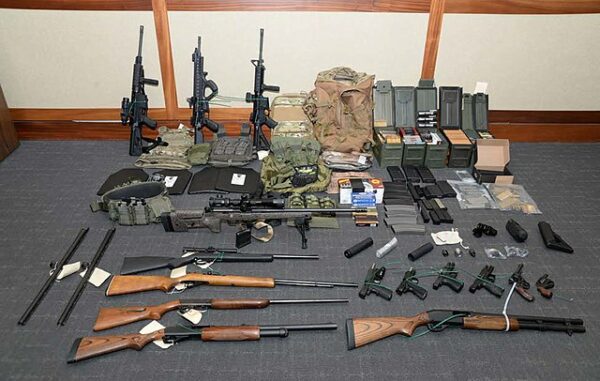
The suspected attackers were identified as 50-year-old Sajid Akram and his 24-year-old son, Naveed Akram. Authorities said the father and son targeted Jewish people celebrating Hanukkah, and officials have described the shooting as an act of antisemitic terrorism. Videos from the scene appear to show the gunmen using bolt-action rifles, though police also reportedly recovered shotguns. Authorities have not confirmed exactly which firearms were used to carry out the attack, but officials stated at a press conference that Sajid possessed firearms legally.
Sajid Akram was killed at the scene by responding police officers. His son Naveed was wounded and remains in a coma. Footage from the attack showed a bystander charging one of the gunmen and wrestling the weapon away. That man was later identified as Ahmed al Ahmed, an immigrant from Syria, who was shot in the shoulder and underwent surgery on Monday.
Officials said the younger Akram had previously been on authorities’ radar. Naveed was investigated in 2019 over alleged ties to ISIS, but officials ultimately concluded he did not pose an ongoing threat at the time. “He was examined on the basis of being associated with others and the assessment was made that there was no indication of any ongoing threat or threat of him engaging in violence,” Albanese said.
Sajid Akram immigrated to Australia in 1998 on a student visa and later became a permanent resident after marrying an Australian citizen. His son was born in Australia.
As the country mourns the victims of the attack, Australian leaders are once again turning to gun restrictions as their primary policy response, even as questions remain about extremism, enforcement failures, and how such violence occurred under an already highly restrictive gun control regime.
[READ MORE: Holocaust Survivor Killed Protecting Wife in Brutal Hanukkah Mass Shooting at Bondi Beach]