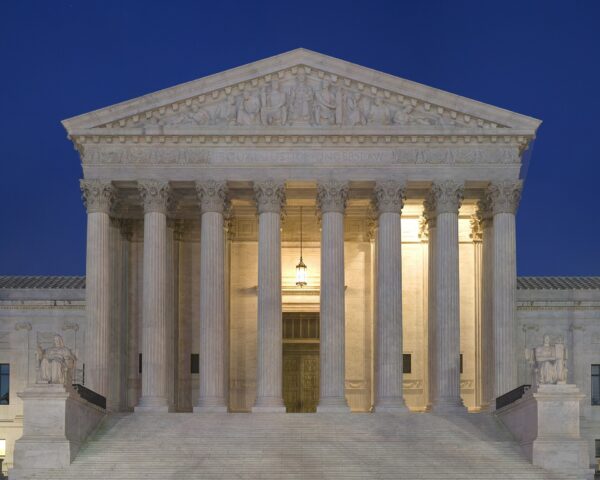
The Supreme Court on Monday will reportedly weigh one of the most consequential separation-of-powers cases in modern history as it considers President Donald Trump’s challenge to fire a Federal Trade Commission (FTC) member without cause.
A ruling in Trump’s favor could overturn nearly a century of precedent shielding leaders of independent agencies from presidential oversight — a protection that critics say has fueled the growth of an unaccountable administrative state.
The case centers on Trump’s removal of Rebecca Slaughter, a Democrat appointed to the FTC in 2018. Trump dismissed her earlier this year, arguing her service was “inconsistent” with his administration’s policies.
But federal law says FTC commissioners can be fired only for “inefficiency, neglect of duty, or malfeasance.” Trump’s decision to remove her — and several other protected officials — has triggered multiple lawsuits.
At the heart of the dispute is the Supreme Court’s 1935 decision in Humphrey’s Executor v. United States, which upheld for-cause removal protections for FTC commissioners and cemented Congress’s power to insulate certain bureaucrats from presidential authority.
Lower courts, bound by that precedent, have largely ruled against Trump. But now the issue rests with the only institution capable of overturning its own rulings.
Several justices have already signaled strong skepticism toward Humphrey’s Executor. Justice Clarence Thomas, joined by Justice Neil Gorsuch, warned in 2020 that the decision “poses a direct threat to our constitutional structure and, as a result, the liberty of the American people.” Their position aligns closely with Trump’s argument: independent agency protections violate Article II by blocking the president from overseeing the executive branch.
Solicitor General D. John Sauer, arguing Monday on behalf of the administration, urged the Court to end the precedent once and for all. “The Court should repudiate anything that remains of Humphrey’s Executor and ensure that the President, not multimember agency heads, controls the executive power that Article II vests in him alone,” Sauer wrote.
Trump’s position has drawn broad support across the conservative legal movement. The National Civil Liberties Alliance, Cato Institute, Pacific Legal Foundation, and the U.S. Chamber of Commerce have all filed briefs backing the administration.
Slaughter, however, is being represented by Amit Agarwal — a former top legal adviser under Florida Attorney General Pam Bondi and now an attorney with Protect Democracy, a group that frequently challenges Trump. Agarwal accuses the White House of trying to strip Congress of its authority and undermine decades-old safeguards.
He argued the administration seeks to “vindicate the principle of democratic political accountability” by asking courts to eliminate laws enacted by elected representatives.
Slaughter’s defense has attracted backing from the AFL-CIO, former independent agency heads, Public Citizen, 22 Democratic attorneys general, and roughly 200 Democratic members of Congress.
This case is the first of two major showdowns over the limits of presidential power to remove officials at independent agencies. In January, the Court will hear Federal Reserve governor Lisa Cook’s challenge to Trump’s attempt to fire her over mortgage-fraud allegations she denies.
For now, all eyes are on Monday’s oral arguments — a moment that could redefine the balance of power between the presidency and a sprawling federal bureaucracy long shielded from democratic accountability.
[READ MORE: Michigan Health Department Refuses To Work With Trump]