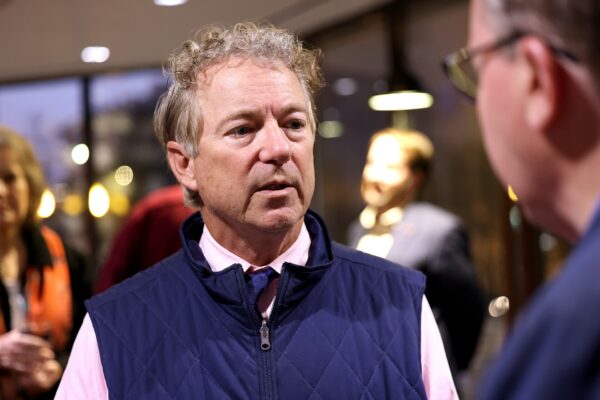
Senator Rand Paul is now reportedly raising serious concerns about the Trump administration’s growing military presence in the Caribbean, warning that recent strikes on alleged drug runners may be setting the stage for something far larger. In an interview Thursday with Stuart Varney on Fox Business Network, Paul was pressed on what Varney called a “huge military build-up” in the region. Paul did not hesitate to frame the developments as highly consequential.
“I think the boat attacks are a prelude to an invasion of Venezuela,” Paul said, laying out a stark assessment of the Trump administration’s escalating posture. While Paul has long aligned himself with conservative skepticism toward foreign interventions, he made clear that what he sees unfolding in the Caribbean represents a return to an interventionist mindset that many believed Trump had rejected.
Paul emphasized that one of the reasons he originally supported Trump was the president’s criticism of past U.S. wars. Trump had openly opposed the Iraq War and was skeptical of military action in Libya, positions that resonated with conservatives who distrust expansive foreign entanglements. Paul argued that such skepticism had been rooted in the lessons of decades of costly regime-change operations that often produced more instability than solutions.
“I don’t like the idea of an offensive war, I don’t like the idea of regime change,” Paul stressed. He pointed to the heavy toll such operations have taken “both in lives and in treasure,” and suggested that repeating those mistakes would run counter to the very principles that once distinguished Trump’s approach to foreign policy. Though he maintained hope that an invasion was not inevitable, Paul said that the current trajectory “certainly looks like it’s a possibility.”
When Varney pushed him further, asking what the alternative might be to what appears to be a rapidly expanding military operation, Paul offered a worldview that diverges sharply from interventionist thinking. He argued that America must recognize the limits of its ability to shape outcomes abroad.
According to Paul, the alternative is accepting that the world is often “messy” and that the United States cannot impose ideal governance everywhere. He noted that South America frequently has multiple left-leaning or socialist leaders, including in places like Colombia, but that it has never been U.S. policy to engage in regime change solely based on ideological disagreement. While he acknowledged that socialism is deeply harmful, Paul insisted that replacing governments through military intervention is not a viable or responsible policy.
He pointed to China as another example, recalling the lasting despair among many Chinese citizens since Tiananmen Square. Yet despite those abuses, Paul noted that it is not U.S. policy—“at least rational people don’t”—to pursue regime change there either.
Ultimately, Paul framed the situation as a test of America’s restraint, arguing that although the nation should continue striving for a more stable world, it does not possess “the ability or the obligation to replace governments around the world.” His warning comes as military activity in the Caribbean continues to intensify, raising questions about how far the administration intends to go and what the consequences may be for the region and for American foreign policy more broadly.
[READ MORE: Rep. Anna Paulina Luna Moves to Force Vote on Congressional Stock Trading Ban, Bypassing GOP Leadership]