President Donald Trump on Tuesday signed the Taiwan Assurance Implementation Act, a measure that orders the State Department to reassess and update its guidelines for official dealings with Taiwan at least once every five years — a formal codification of the warmer posture toward Taipei that first emerged during his earlier term.
The law effectively locks in the shift launched in January 2021, when then–Secretary of State Mike Pompeo swept away decades-old restrictions that had kept American and Taiwanese officials at arm’s length since the United States transferred diplomatic recognition from Taipei to Beijing in 1979, according to Reuters. What had once been a matter of bureaucratic discretion is now statutory, signaling to allies and adversaries that Washington intends to treat engagement with Taiwan as an enduring component of U.S. policy.
Taipei responded with the enthusiasm of a government that has long pressed for more routine, more public contact with American officials. Presidential Office spokesperson Karen Kuo said the law “affirms the value of U.S. interaction with Taiwan, supports closer Taiwan-U.S. relations, and stands as a firm symbol of our shared values of democracy, freedom, and respect for human rights.” Foreign Minister Lin Chia-lung added that the new review requirement could, in practical terms, open more doors in Washington, making it easier for Taiwanese officials to enter federal buildings and conduct business with their U.S. counterparts.
Beijing reacted with equal speed — and fury. At a regular press briefing, Foreign Ministry spokesperson Lin Jian said China “firmly opposes any form of official contact between the United States and ‘the Taiwan region of China’.” He cast the matter as an existential one for Beijing, insisting that the Taiwan question is “the core of China’s core interests and the first red line that must not be crossed in China–U.S. relations,” and demanded that Washington “stop all official interactions between the U.S. and Taiwan, and not to send any wrong signals to ‘Taiwan independence’ separatist forces.”
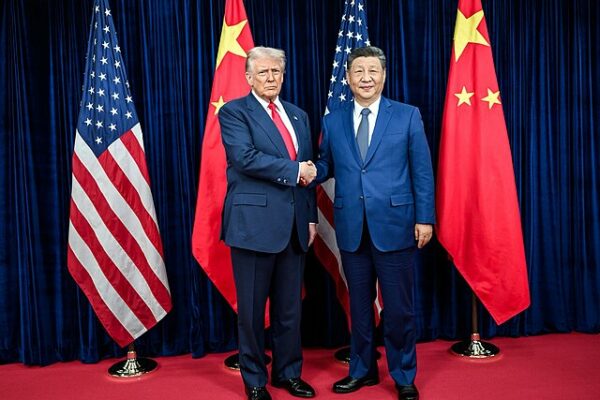
Taipei has repeatedly rejected Beijing’s sovereignty claim, asserting that it maintains the right — and the democratic mandate — to conduct its own foreign affairs. But the cross-Strait standoff now sits within the larger turbulence of U.S.–China relations. Trump, who met Xi Jinping in South Korea in October, is slated to travel to China in April, a visit that now carries additional diplomatic weight.
For all the formal ambiguity surrounding America’s posture toward Taiwan, the strategic reality remains unchanged: the United States is Taipei’s most significant international backer and primary military supplier. This latest law — procedural on its face, symbolic in its intent — ensures that those ties will not quietly decrease any time soon.