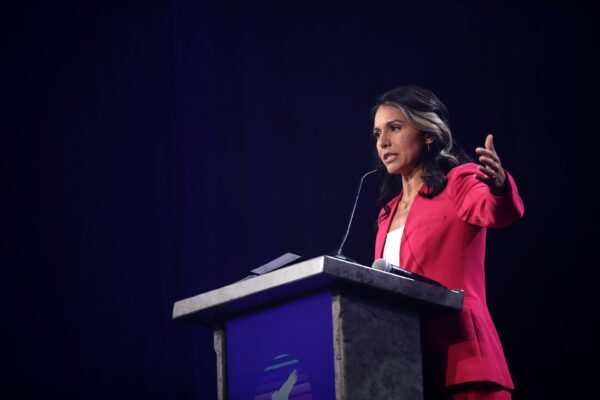
The White House is now reportedly forcefully rejecting speculation that Director of National Intelligence Tulsi Gabbard could be the next high-profile departure, following President Donald Trump’s decision to remove Attorney General Pam Bondi earlier this week.
Administration officials moved quickly Thursday to tamp down reports suggesting unrest within the president’s national security team. White House Communications Director Steven Cheung dismissed the claims outright, saying the president maintains “total confidence” in Gabbard and labeling any suggestion otherwise as “totally fake news.”
Cheung also pointed to what he described as the administration’s broader record, arguing that the president has assembled a Cabinet that has delivered “historic victories” for the American people. His remarks came in direct response to a report from The Guardian, which claimed Trump had privately polled Cabinet members about potentially replacing Gabbard.
At the center of the controversy is a growing divide over the administration’s military actions abroad—specifically, the ongoing conflict with Iran. The report suggested tensions may have escalated after Gabbard declined to publicly criticize Joe Kent, a former deputy who resigned in protest of the U.S. role in the conflict.
Kent’s resignation letter offered a stark critique of the administration’s decision-making, asserting that Iran “posed no imminent threat” and alleging that the war was driven by external pressure tied to Israel and its allies in the United States. His departure injected fresh scrutiny into a military operation that has already raised difficult questions in Washington.
The joint U.S.-Israel strikes on Iran began on Feb. 28, at a time when nuclear deal negotiations were still ongoing. Now entering its fifth week, the conflict has prompted lawmakers from both sides of the aisle to question its objectives, timeline, and long-term consequences. While the administration has framed the operation as necessary for national security, critics have pressed for clearer answers on what defines success—and how long the engagement may last.
Gabbard herself has walked a careful line. Appearing before the Senate Intelligence Committee days after Kent’s resignation, she avoided directly answering whether Iran posed an “imminent threat” to the United States. Instead, she emphasized the president’s authority in making that determination.
In a statement posted ahead of the hearing, Gabbard said Trump had concluded that Iran represented such a threat and acted accordingly. She underscored that, as commander in chief, the president bears ultimate responsibility for assessing threats and taking action to protect American troops and citizens.
That stance reflects a broader theme within the administration: deference to executive judgment in matters of war and peace. Yet the ongoing debate—both inside Washington and beyond—suggests that not all are convinced the case has been fully made.
Even as the White House insists that unity remains intact, the backdrop of an expanding overseas conflict continues to test that message. Press Secretary Karoline Leavitt reiterated after Kent’s resignation that the president retains full confidence in Gabbard, signaling that, at least for now, no shake-up is imminent.
Still, as the conflict stretches on and questions persist, the political and human costs of another prolonged military engagement remain difficult to ignore—underscoring the weight of decisions made far from home.