President Donald Trump on Sunday ordered a U.S. naval blockade of the Strait of Hormuz, escalating tensions in the Middle East after nearly 20 hours of peace talks with Iran collapsed without an agreement.
The negotiations, held in Islamabad, broke down largely over Iran’s refusal to abandon its nuclear program, according to U.S. officials. Trump, writing on Truth Social, said most issues had been resolved except what he described as the central sticking point.
🚨MAJOR BREAKING: JD Vance just announced that after 21 hours, the Iran negotiations have failed, and he's returning without a deal.
Trump turned ‘America 1st’ into ‘America Begs’ on the world stage.
Watch him dodging questions about the opening of Hormuz. Utterly HUMILIATING. pic.twitter.com/OdoGAQbi8a
— CALL TO ACTIVISM (@CalltoActivism) April 12, 2026
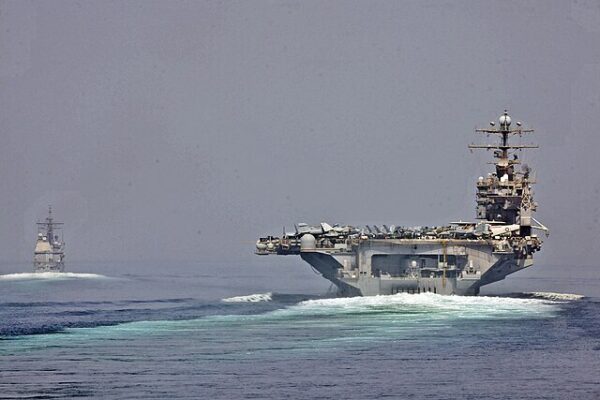
“Effective immediately, the United States Navy, the Finest in the World, will begin the process of BLOCKADING any and all Ships trying to enter, or leave, the Strait of Hormuz,” Trump wrote.
He added: “There is only one thing that matters — IRAN IS UNWILLING TO GIVE UP ITS NUCLEAR AMBITIONS! As I have always said, right from the beginning, and many years ago, IRAN WILL NEVER HAVE A NUCLEAR WEAPON!”
The Strait of Hormuz, a narrow waterway between the Persian Gulf and the Gulf of Oman, carries roughly one-fifth of the world’s oil and liquefied natural gas shipments. Recent Iranian restrictions on traffic—while allowing passage for select nations and considering tolls—have already pushed global energy prices higher and raised concerns about fuel shortages, including potential disruptions to jet fuel supplies in Europe.
Trump accused Iran of engaging in “world extortion” through its control of the strait and directed U.S. forces to expand their operations in the region. He said the Navy would “seek and interdict every vessel in International Waters that has paid a toll to Iran,” while also moving to clear mines believed to have been laid by Iranian forces.
“Any Iranian who fires at us, or at peaceful vessels, will be BLOWN TO HELL!” Trump stated.
The U.S. delegation in Islamabad was led by Vice President JD Vance and included special envoy Steve Witkoff and adviser Jared Kushner. The group pressed for a firm Iranian commitment to forgo nuclear weapons development or the capacity to rapidly produce them. Vance later described the American position as its “final and best offer.”
Iranian officials offered a sharply different account. Parliament Speaker Mohammad Bagher Qalibaf said in a post on X that Iran had negotiated “in good faith,” but that the United States “failed to gain the trust of the Iranian delegation in this round of negotiations.” He added that future talks remain possible if Washington can rebuild that trust.
Tehran has long maintained that its nuclear program is for civilian purposes, a claim disputed by Western governments. Iran was a signatory to the 2015 nuclear agreement before the United States withdrew during Trump’s first administration, writes Yahoo News.
In a subsequent Fox News interview, Trump signaled a willingness to escalate further, warning of a potential 50% tariff on Chinese imports if Beijing provides military support to Iran. He also said the United States retains the capability to strike Iran’s energy infrastructure if necessary.
The talks in Islamabad—hosted by Pakistani Prime Minister Shehbaz Sharif and Army Chief Asim Munir—represented the highest-level direct engagement between the United States and Iran since the 1979 Islamic Revolution. Pakistani officials said they would continue efforts to mediate.
International reaction was swift, with the United Kingdom, the European Union, and Russia calling for restraint amid fears of a broader regional conflict.
Iran’s Revolutionary Guards responded defiantly, asserting control over the strait and warning that any attempt to challenge it would result in a “deadly vortex.”
The latest developments come amid a six-week conflict that began with U.S. and Israeli strikes on Iran that killed Supreme Leader Ali Khamenei. Markets are already bracing for further volatility in global energy supplies, while civilians across the region face growing uncertainty.
Trump framed the blockade as a necessary step to prevent Iran from leveraging its position over global shipping lanes.
“Iran will not be allowed to profit off this Illegal Act of EXTORTION,” he said.
As of Sunday afternoon, U.S. naval forces were preparing to implement the blockade, even as diplomatic channels remain technically open following the breakdown in talks.