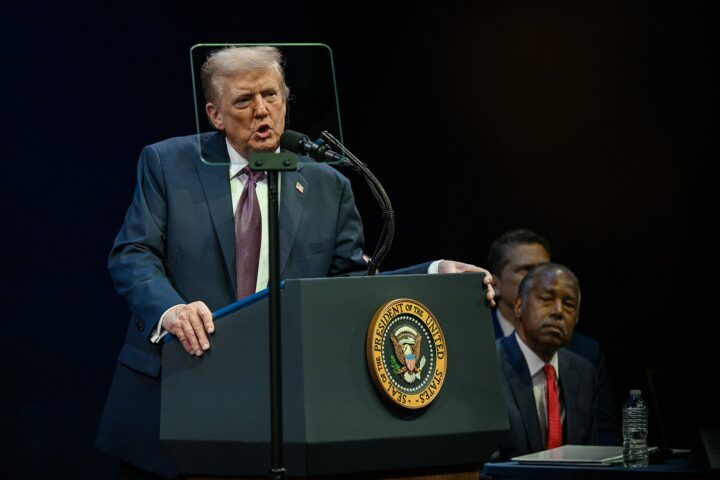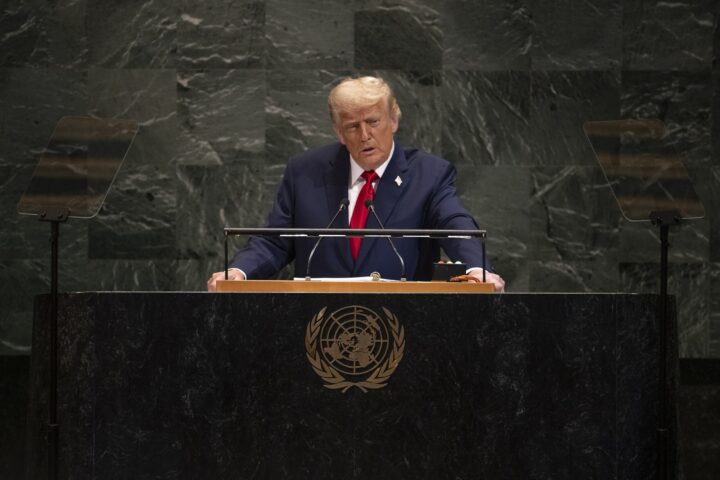
President Donald Trump on Saturday announced a sweeping new tariff regime targeting Denmark and seven other European nations, escalating his long-running effort to pressure Copenhagen into negotiating the sale of Greenland, the vast Arctic territory that remains under Danish sovereignty.
In a social media post, Trump said the United States would impose a 10 percent tariff on all goods imported from Denmark, Norway, Sweden, France, Germany, Britain, the Netherlands, and Finland beginning February 1. If no agreement is reached by June 1 for what he described as the “Complete and Total purchase of Greenland,” the tariffs would rise to 25 percent. All eight countries are NATO allies that have publicly backed Denmark’s refusal to sell the territory.
Trump framed the move as a national security imperative, arguing that Greenland’s strategic location is critical to countering potential Chinese and Russian influence in the Arctic. While noting that the United States already holds military rights on the island under a 1951 defense agreement with Denmark, he contended that full ownership is necessary to ensure long-term security. In his post, Trump also argued that the U.S. has long subsidized Denmark and other European countries through low or nonexistent tariffs and security guarantees, asserting that it was time for Denmark to “give back” because “World Peace is at stake!”
The announcement represents a sharp escalation following weeks of quiet diplomacy. Recent meetings in Washington between Danish and Greenlandic officials and senior Trump administration figures, including Vice President JD Vance and Secretary of State Marco Rubio, failed to produce any movement toward a deal.
European leaders responded swiftly and forcefully. French President Emmanuel Macron stated that “No intimidation or threat will influence us — neither in Ukraine, nor in Greenland, nor anywhere else in the world when we are confronted with such situations.” He described the tariff threats as “unacceptable” and pledged a “united and coordinated” European response to defend sovereignty.
British Prime Minister Keir Starmer said imposing tariffs on allies acting in line with NATO’s collective security mission is “completely wrong,” and said his government would pursue direct engagement with Washington. Sweden’s prime minister echoed that view, insisting that only Denmark and Greenland have the authority to decide the territory’s future and rejecting what he characterized as economic blackmail.
Leaders of the European Union also rallied behind Copenhagen. European Commission President Ursula von der Leyen and European Council President António Costa issued a joint statement expressing full solidarity with Denmark and Greenland. They warned that the proposed tariffs would “undermine transatlantic relations and risk a dangerous downward spiral,” while emphasizing that existing Arctic security cooperation poses no threat to the United States.
The tariff threat also raises unresolved legal questions. The Supreme Court is expected to rule soon on Trump’s use of the International Emergency Economic Powers Act to impose trade measures unilaterally. Existing U.S. tariffs already include roughly 10 percent on British goods and 15 percent on European Union imports, meaning the proposed measures could stack additional costs onto supply chains—costs that importers and American consumers would ultimately bear.
Analysts warned that the move could unravel recent transatlantic trade arrangements and deepen strains within NATO, with some cautioning that the threat could spiral into a full-scale trade war. Over the weekend, protests erupted in both Greenland and Denmark, where demonstrators rejected any sale of the territory and condemned the use of economic pressure to force the issue.