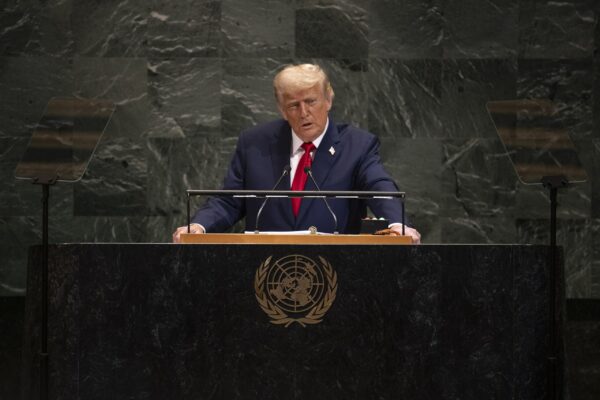
President Donald Trump said seizing Iranian oil assets—including the strategic export hub at Kharg Island—remains under consideration, even as indirect negotiations with Tehran continue amid an expanding Middle East conflict.
In an interview with The Financial Times published Sunday, Trump signaled a preference for taking control of Iran’s النفط infrastructure, drawing comparisons to U.S. actions in Venezuela following the capture of Nicolás Maduro earlier this year. He indicated that Washington intends to manage that country’s oil sector on an ongoing basis.
Trump told the The Financial Times: “To be honest with you, my favourite thing is to take the oil in Iran but some stupid people back in the US say: ‘why are you doing that?’ But they’re stupid people.”
Kharg Island functions as the central node for the vast majority of Iran’s oil exports, making it one of the most strategically sensitive energy sites in the region. Analysts note that any attempt to seize the island would constitute a major military operation, likely requiring a sustained American presence and exposing U.S. forces to retaliation.
“Maybe we take Kharg Island, maybe we don’t. We have a lot of options,” Trump said. “It would also mean we had to be there [in Kharg Island] for a while.”
Asked about Iranian defenses, he added: “I don’t think they have any defence. We could take it very easily.”
The remarks come as the United States expands its military footprint in the region, with thousands of troops—including Marines and elements of the 82nd Airborne Division—deployed or en route. The buildup coincides with a broader U.S.-Israeli campaign against Iran that has sharply disrupted global energy markets, pushing oil prices above $115 per barrel amid fears of supply shocks.
Recent escalations have included an Iranian-linked strike on a Saudi air base that injured U.S. personnel, as well as continued Houthi missile activity targeting Israel, widening the conflict’s regional scope.
Despite his rhetoric on seizing oil assets, Trump emphasized that backchannel diplomacy—reportedly facilitated through Pakistani intermediaries—remains active. He has set an April 6 deadline for Iran to accept terms to end hostilities, warning that failure to reach an agreement could trigger further strikes on the country’s energy infrastructure.
“We’ve got about 3,000 targets left — we’ve bombed 13,000 targets — and another couple of thousand targets to go,” he said. “A deal could be made fairly quickly.”
Trump also pointed to developments in maritime traffic through the Strait of Hormuz, a critical global shipping corridor, claiming Iran had permitted additional Pakistan-flagged oil tankers to transit the waterway.
“They gave us 10,” he said. “Now they’re giving 20 and the 20 have already started and they’re going right up the middle of the Strait.” He described the initial allowance as a “present” to the White House.
The president further asserted that Iran’s leadership had shifted significantly during the conflict, describing negotiators as “a totally different group of people . . . [They] are very professional.” He repeated earlier claims that longtime Supreme Leader Ayatollah Ali Khamenei had been killed early in the war and suggested his son, Mojtaba Khamenei, was either dead or incapacitated.
“The son is either dead or in extremely bad shape,” Trump said. “We’ve not heard from him at all. He’s gone.”
Military analysts warn that any effort to seize Kharg Island would likely escalate the conflict further, increase the risk of American casualties, and intensify disruptions to global oil markets already strained by the war.
Secretary of State Rubio has said that the war could last between four to six more weeks.
[Read More: Vance Says America Has Completed Most Of Its Objectives]