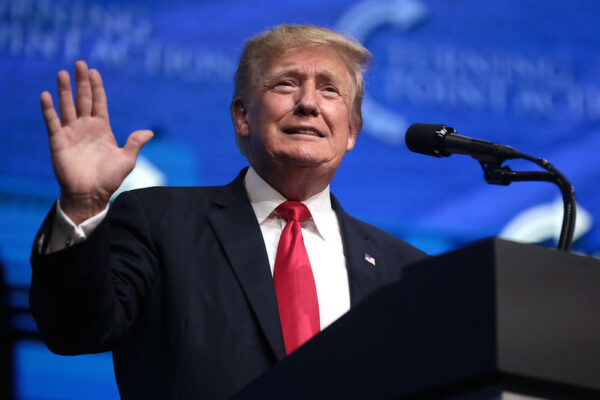
President Donald Trump said Wednesday that the Strait of Hormuz remains “in great shape” despite nearly two weeks of disrupted maritime traffic and intensifying hostilities between the United States, Israel, and Iran.
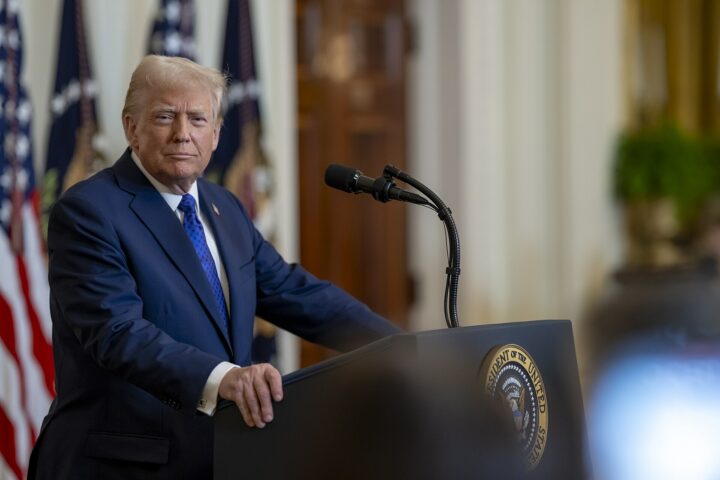
Speaking to reporters at Joint Base Andrews, Trump dismissed concerns that the vital shipping corridor had effectively been shut down by Iranian actions.
“The straits are in great shape,” Trump said. “We’ve knocked out all of their boats. They have some missiles, but not very many. I think we’re in very good … we’re in very good shape.”
The Strait of Hormuz — the narrow channel linking the Persian Gulf to the Gulf of Oman — carries roughly one-fifth of the world’s oil supply. Since the outbreak of the current conflict, Iranian forces, particularly the Islamic Revolutionary Guard Corps (IRGC), have enforced what amounts to a de facto blockade, declaring that not “even a single liter of oil” will pass through the strait until U.S. and Israeli military operations cease.
Tensions escalated further this week. On Wednesday, three cargo ships in the Gulf were struck by unidentified projectiles, according to the United Kingdom Maritime Trade Operations (UKMTO). The incidents added to at least 16 vessel attacks reported near Iran’s coastline in recent days.
The day before, U.S. Central Command announced the destruction of 16 Iranian mine-laying vessels operating in the strait, part of a broader effort to keep the waterway navigable.
Trump argued the Iranian military has been effectively neutralized.
“They are pretty much at the end of the line,” he said of the Iranian regime. “Doesn’t mean we’re going to end it immediately, but they are. They’ve got no navy, they’ve got no air force, they’ve got no anti-air traffic anything. They have no systems of control.”
“We’re just riding free range over that country,” he added.
Trump said the central objective of the campaign is ensuring a decisive outcome.
“The main thing is we have to win this,” Trump stated. “Most people say it’s already been won. It’s just a question of when. When do we stop? We don’t want to let it regrow, and ideally would like to see somebody in there that knows what they’re doing.”
At the same time, the president warned that the United States retains the ability to cripple Iran’s infrastructure if the conflict escalates further.
“We can hit sections of Tehran and other places that if you do it, it’ll be almost impossible for them to rebuild their country, and we don’t want that. But we can hit electric … we could take apart their electric capacity within one hour, and it would take them 25 years to rebuild it. So ideally, we’re not going to be doing that,” Trump said.
The disruption to shipping through the strait has already rippled through global energy markets. Brent crude briefly surged past $100 per barrel overnight before easing to roughly $98 by Thursday morning.
To stabilize supplies, the United States announced it would release 172 million barrels from the Strategic Petroleum Reserve. The International Energy Agency also coordinated a collective release of roughly 400 million barrels among member countries.