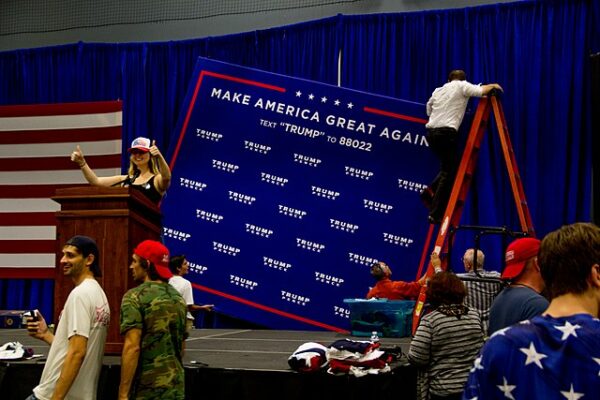
President Donald Trump will travel to the Mount Airy Casino Resort in eastern Pennsylvania on Tuesday, launching a new slate of domestic appearances aimed at convincing voters that his administration is aggressively tackling persistent cost-of-living pressures. The effort comes as Republicans confront unusually sharp voter anxiety over day-to-day expenses — including food, housing, energy, and medical bills — ahead of next year’s midterm elections.
The White House is increasingly aware that economic discontent has begun reshaping voter behavior, including last month’s off-year contests where Democrats capitalized on affordability concerns to regain ground in areas that once leaned Republican. Polling suggests the problem is not confined to a few regions. A November Gallup survey found 40% of Americans now describe economic conditions as “poor,” while a Fox News poll showed 76% of voters rating the economy negatively. The most politically damaging development for Republicans has been erosion among voters who cite inflation and rising prices as their top concern.
Within the administration, aides openly acknowledge the stakes. “Everybody gets it at the White House,” one Trump adviser told CNN. “We’ve got a lot of work to go, and it’s frustrating for the president, but it’s what we’ve got to deal with.” The question is no longer whether the inflation narrative is resonating but whether the president can make a persuasive case that his administration has both recognized the problem and is acting quickly enough to relieve it.
Trump has often insisted the affordability squeeze is more perception than reality, and in recent weeks has described the issue as a “Democratic hoax” and a “con job.” Advisers have urged him privately to stop dismissing public frustration and to show more visible empathy for households that feel cornered by higher prices. According to one senior administration official, Trump “feels this is a communication issue” and “wants Republicans to step it up in talking about all the good work being done to improve the economy.”
White House spokesperson Kush Desai reinforced the president’s preferred framing, calling the current price environment “Joe Biden’s inflation and affordability crisis” and insisting that “President Trump is highlighting the meaningful progress that his Administration has made and will continue to make.” The message reflects what officials describe as a dual challenge: responding to voter concerns while continuing to argue that the administration inherited the current economic environment rather than caused it.
Republicans in competitive districts are less inclined to treat the affordability problem as political theater. Rep. Brian Fitzpatrick (R-PA), who represents a swing district Trump lost in 2024, said the financial strain among his constituents is unmistakable. “That trumps everything else,” Fitzpatrick said, noting that voters routinely relay stories of rising bills. He also rejected the president’s suggestion that inflation concerns are contrived: “I don’t believe that to be true at all. … We know it’s real.”
Tuesday’s stop sits in a politically revealing area — a northeastern Pennsylvania district Trump won handily but where the GOP barely held its congressional seat in 2024. White House advisers see the visit as an early test of whether Trump will adjust his tone toward one that acknowledges economic anxieties more directly, or whether he will lean on claims that the economy is already outperforming historic benchmarks and that voters simply have not fully absorbed the good news.
The tour comes as Treasury Secretary Scott Bessent has been hitting national news programs to talk about inflation and economic growth. On CBS’s “Face the Nation” over the weekend, he insisted that the root of the hardship lies with the policies of the prior administration. He described the Biden period as producing “the worst inflation in 50 years, and maybe for working Americans, the worst inflation of all time.”
To illustrate the real burden on blue-collar families, Bessent highlighted an internal metric: the “Common Man CPI,” a weighted basket emphasizing food, gasoline, and rent. Under Biden, it rose by roughly 35 percent cumulatively — far worse than the official consumer price index. Bessent said that for the first time in 2025, the Common Man measure is running below headline inflation, giving lower-income families meaningful relief. “Real incomes are up about 1 percent… This year the basket of goods for working Americans — food, gasoline, rent — is coming down,” he said.
For Republicans defending slender House and Senate majorities, the question is whether a communications offensive can persuade skeptical voters that pocketbook relief is imminent. If not, the party risks confronting a midterm backlash driven by the most familiar political force of all — rising kitchen-table costs.